29 October 2020

The better angels of our nature


Whichever way the election goes, and regardless of whom we voted for, should we be disappointed, violence is not an acceptable response.


I was going to write a post about options for nonviolent civil disobedience in the event one side tries to steal the election, such as a general strike, but I think instead I’m just going to encourage everybody to chill out and remember these lines from Lincoln's Inaugural Address:

We are not enemies, but friends. We must not be enemies. Though passion may have strained it must not break our bonds of affection. The mystic chords of memory, stretching from every battlefield and patriot grave to every living heart and hearthstone all over this broad land, will yet swell the chorus of the Union, when again touched, as surely they will be, by the better angels of our nature.

I invite you to also read Lincoln’s Second Inaugural Address, reprinted in its entirety below, and recall that in between those two addresses, over 620,000 American lives were lost.


Second Inaugural Address.

Delivered at Washington, D. C. March 4, 1865.

Fellow-countrymen: At this second appearing to take the oath of the presidential office, there is less occasion for an extended address than there was at the first. Then a statement, somewhat in detail, of a course to be pursued, seemed fitting and proper. Now, at the expiration of four years, during which public declarations have been constantly called forth on every point and phase of the great contest which still absorbs the attention and engrosses the energies of the nation, little that is new could be presented. The progress of our arms, upon which all else chiefly depends, is as well known to the public as to myself; and it is, I trust, reasonably satisfactory and encouraging to all. With high hope for the future, no prediction in regard to it is ventured.

On the occasion corresponding to this four years ago, all thoughts were anxiously directed to an impending civil war. All dreaded it—all sought to avert it. While the inaugural address was being delivered from this place, devoted altogether to saving the Union without war, insurgent agents were in the city seeking to destroy it without war—seeking to dissolve the Union, and divide effects, by negotiation. Both parties deprecated war; but one of them would make war rather than let the nation survive; and the other would accept war rather than let it perish. And the war came.

One-eighth of the whole population were colored slaves, not distributed generally over the Union, but localized in the Southern part of it. These slaves constituted a peculiar and powerful interest. All knew that this interest was, somehow, the cause of the war. To strengthen, perpetuate, and extend this interest was the object for which the insurgents would rend the Union, even by war; while the government claimed no right to do more than to restrict the territorial enlargement of it.

Neither party expected for the war the magnitude or the duration which it has already attained. Neither anticipated that the cause of the conflict might cease with, or even before, the conflict itself should cease. Each looked for an easier triumph, and a result less fundamental and astounding. Both read the same Bible, and pray to the same God; and each invokes his aid against the other. It may seem strange that any men should dare to ask a just God's assistance in wringing their bread from the sweat of other men's faces; but let us judge not, that we be not judged. The prayers of both could not be answered—that of neither has been answered fully.

The Almighty has his own purposes. "Woe unto the world because of offenses! for it must needs be that offenses come; but woe to that man by whom the offense cometh." If we shall suppose that American slavery is one of those offenses which, in the providence of God, must needs come, but which, having continued through his appointed time, he now wills to remove, and that he gives to both North and South this terrible war, as the woe due to those by whom the offense came, shall we discern therein any departure from those divine attributes which the believers in a living God always ascribe to him? Fondly do we hope—fervently do we pray—that this mighty scourge of war may speedily pass away. Yet, if God wills that it continue until all the wealth piled by the bondman's two hundred and fifty years of unrequited toil shall be sunk, and until every drop of blood drawn with the lash shall be paid by another drawn with the sword, as was said three thousand years ago, so still it must be said, "The judgments of the Lord are true and righteous altogether."

With malice toward none; with charity for all; with firmness in the right, as God gives us to see the right, let us strive on to finish the work we are in; to bind up the nation's wounds; to care for him who shall have borne the battle, and for his widow, and his orphan—to do all which may achieve and cherish a just and lasting peace among ourselves, and with all nations.

18 September 2020

Authors, Roles, and Subjects

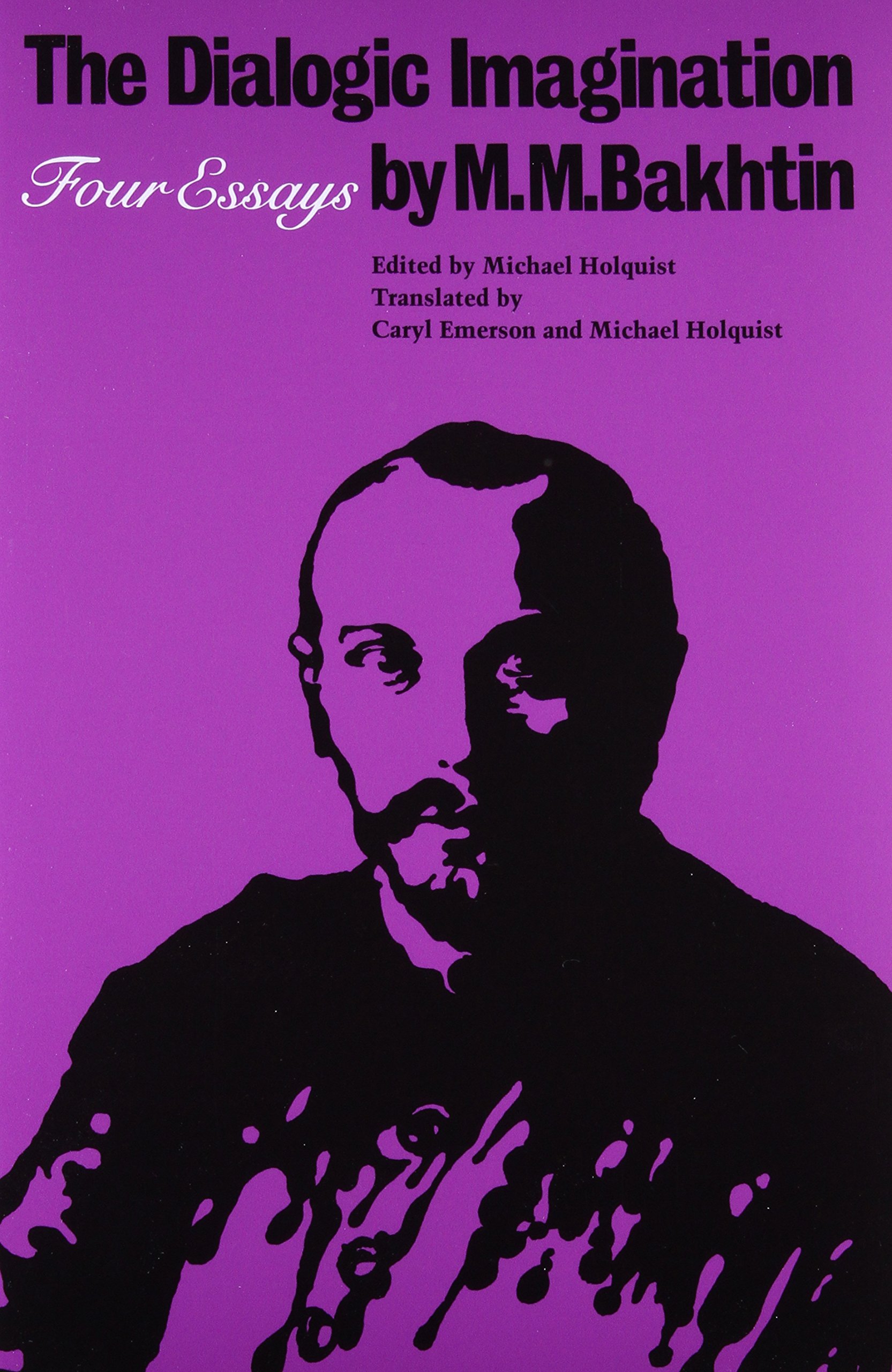
The Dialogic Imagination: Four Essays (University of Texas Press Slavic  Series): Bakhtin, M. M., Holquist, Michael, Emerson, Caryl, Holquist,  Michael: 0884217849726: Amazon.com: Books


Here's another of my old conference papers. This one was presented at the Rhetoric Society of America biennial meeting in 2012. 


Authors, Roles, and Subjects


M. D. Robertson


Mikhail Bakhtin and Michel Foucault present different views of the speaking individual.  Bakhtin’s view suggests that the speaker has a greater degree of freedom than Foucault’s view allows.  Judith Butler’s exploration of the concept of the subject is based on Foucault’s view, but Butler’s concerns about performativity and agency could be addressed more coherently using a notion of the subject that is based on Bakhtin’s view, rather than Foucault’s, and clarified by adding the concept of role.


1. The author in Bakhtin


Michael Holquist, in his introduction to Bakhtin's The Dialogic Imagination, speaks of the phenomenon of language and “that other phenomenon which it ventriloquates, man” (xviii).  This statement suggests that Holquist wants to count Bakhtin among those who say that we do not speak language–language speaks us.


But Bakhtin seems to directly contradict Holquist’s statement when he says, “[The author] speaks, as it were, through language, a language . . . that he merely ventriloquates” (299).  This clearly portrays the author as Edgar Bergen and language as Charlie McCarthy, not vice versa.


Bakhtin’s theory of language is based on the intertwined concepts of dialogism  and heteroglossia.  Against linguistics, stylistics, and the philosophy of language, which all posit unitary and discrete normative national languages and individuals who each speak in exactly one such language (or exactly one deviant version of such a language), Bakhtin asserts that such a view of language is a fictional abstraction.  Actual language in use is always caught in the interplay between “centripetal” forces that tend towards greater standardization of speech, and “centrifugal” forces that tend towards greater diversity of speech.  The latter are stronger, both diachronically and synchronically.  Speakers do not speak a single language, they speak a blend of dialects associated with various elements of society, a blend which varies from one utterance to the next.  Heteroglossia refers to the mixture of interacting languages that compose any identifiable national “language”.  Dialogism means that, in non-poetic uses of language, an individual does not speak in a single language of her own choosing; speech (la parole) will always draw from a mixture of languages (les langues), like a ladle dipped into a pot of stew.


Heteroglossia and dialogism shape the dialect(s) that speakers use, but it is a mistake to infer from this that speakers have no control over what they say in those dialects.  Bakhtin’s discussion of authorship makes this clear.


Bakhtin discusses both poetic and prosaic authorship.  The main difference between them is that the poet resists heteroglossia and centripetal and centrifugal forces that shape language and strives to create a language of his own, while the novelist embraces heteroglossia and uses the existing social dialects that he is aware of.  

In the majority of poetic genres . . . the internal dialogization of discourse is not put to artistic use, it does not enter into the work’s ‘aesthetic object’.  In the novel, however, this internal dialogization becomes one of the most fundamental aspects of prose style and undergoes a specific artistic elaboration. (284)

But in neither case is the author’s intentions determined by the language.

The language of the poet is his language . . . he makes use of each form, each word, each expression . . . as a pure and direct expression of his own intention. (285)

The prose writer makes use of words that are already populated with the social intentions of others and compels them to serve his own new intentions, to serve a second master. (300)

The novelist can be compared to a sailor, who does not control the winds and currents, but is able to harness them and arrive at a destination of his own choosing.

2. The subject in Foucault


Foucault also discusses authorship (broadly construed) in The Archaeology of Knowledge, and he shares Bakhtin’s concern with the concrete use of language in particular social contexts, as opposed to abstract analyses of language. Foucault focuses on “statements”, which he describes but does not define. He distinguishes statements from propositions, sentences, and speech acts; he seems to have in mind roughly what French linguists call “the utterance” (l’énoncé), but with special attention paid to the relationship between the statement and the “subject” of the statement (92), which he distinguishes from the author:

But the “author” is not identical with the subject of the statement; and the relation of production that he has with the formulation is not superposable to the relation that unites the enunciating subject and what he states. . . . .

So it seems that while the author may “produce” language, it is the subject which originates statements.

Unfortunately, Foucault is not altogether clear about what he means by the subject.

Generally speaking, it would seem, at first sight at least, that the subject of the statement is precisely he who has produced the various elements, with the intention of conveying meaning.  Yet things are not so simple. . . . the statements of the novel do not have the same subject when they provide, as if from the outside, the historical and spatial setting of the story, when they describe things as they would be seen by an anonymous, invisible, neutral individual . . . , or when they provide . . . the verbal version of what is silently experienced by a character.  Although the author is the same in each case, . . . . they do not imply the same relation between this subject and what is being stated. (93)

Let it be noted that Bakhtin is able to take these distinctions into account and still show how and in what sense the author is the originator of the novel.  

The following is perhaps the clearest indication of what Foucault means by “subject”:

So the subject of the statement should not be regarded as identical with the author of the formulation. . . . . it is a particular, vacant place that may in fact be filled by different individuals . . . . (95)

Thus, Foucault distinguishes between the individual (the author) and the subject.    The metaphor of subject as place reoccurs in this quotation:

If a proposition, a sentence, a group of signs can be called “statement”, it is not therefore because, one day, someone happened to speak them or put them into some concrete form of writing; it is because the position of the subject can be assigned.  To describe a formulation qua statement does not consist in analyzing the relations between author and what he says (or wanted to say, or said without wanting to); but in determining what position can and must be occupied by any individual if he is to be the subject of it.  (95)

So it seems that statements emanate from positions that individuals occupy, not from individuals themselves.  


3. The subject in Butler


Butler acknowledges her debt to Foucault in her account of the subject, especially his account of assujetissement in Power/Knowledge, History of Sexuality, and Discipline and Punish  (Butler, 16).  According to this account, how an individual comes to occupy a given subject position is a function of the “regulatory power” that is described in Discipline and Punish, or some similar discursively mediated social process, or possibly a set of conflicting processes of opposing powers, but in any case neither the subject nor the statements that emanate from it originate with the individual.   


If this is what Foucault means*, then his theory, and not Bakhtin’s, is the one in which language “ventriloquates” man, or rather, power ventriloquates man.  The subject position, from which statements emanate, is constituted by power relations and imposed upon the individual, unlike Bakhtin’s author, who freely originates his own communicative intentions.


Following Foucault, Butler also distinguishes the subject from the individual.  In her work The Psychic Life of Power, she says,

“The subject” is sometimes bandied about as if it were interchangeable with “the person” or “the individual”.  The genealogy of the subject as a critical category, however, suggests that the subject, rather than be identified strictly with the individual, ought to be designated as a linguistic category, a placeholder, a structure in formation.  Individuals come to occupy the site of the subject . . . and they enjoy intelligibility only to the extent that they are, as it were, first established in language. (11)

She continues to explore the distinction between the subject and the individual further in Gender Trouble.  But in her separation of the individual from the subject, she seems to go farther than Foucault.  Foucault separates the subject from the individual in order to elucidate the social construction of knowledge; it is not clear that he intends to present a metaphysical account of personhood, which seems to be how Butler is construing him.  Butler’s metaphysical construal of  Foucault gets her into difficulties, because she has not clearly worked out the relationship between the individual and the subject:

Paradoxically, no intelligible reference to individuals or their becoming can take place without a prior reference to their status as subjects. (11)

This is only the first of several places in which Butler explicitly or implicitly acknowledges paradox, contradiction, or circularity (logical, temporal, and/or causal) in her account of the subject. 

Butler seems to recognize this conceptual difficulty, but apparently she regards it aporetically.  It complicates the issue of agency for her:

As much as a perspective on the subject requires an evacuation of the first person, a suspension of the “I” in the interests of an analysis of subject formation, so a reassumption of that first-person perspective is compelled by the question of agency.

Agency and the first-person perspective are indeed inseparable.  Any account of the subject or individual that makes its behavior completely determined by impersonal forces, be they biological or social, renders the subject devoid of agency in any ethically relevant sense.  But this is precisely what Butler’s analysis of the subject runs the risk of doing when she makes the subject a position constructed by power relations and paradoxically questions the existence of the individual apart from any subject position.

This unnecessary mystification seems to be motivated partly by her rejection of the metaphysics of substance.  She acknowledges the influence of Michel Haar and others who, expanding on a theme of Nietzsche’s, assert that the metaphysics of substance is an illusion based upon the reification of grammatical categories (GT 28).  But such arguments grossly misrepresent substance metaphysics.  The relationship between language and reality is the very first topic that Aristotle takes up in the very first chapter of the very first work of the corpus that has come down to us (Categories), and he clearly shows that a noun and a substance are not the same thing.


Could there be another account of the subject and the individual that will address the issue of agency without taking on the unnecessary burden of refuting Aristotle and Descartes, and which do not get bogged down in paradoxes?  Bakhtin’s account of the author points the way to an alternative.  I will attempt to sketch such an alternative in the following section.


4. Individuals, roles, and subjects


If the distinction between individual and the subject is retained, then to which of these does the first-person perspective pertain?  Clearly to the former, for it is the individual (i.e., the person, the self, the “I”) that suffers, not some “site” or “position” that the individual occupies.


But different individuals suffer in different ways.  Suffering which is properly called oppression or exploitation does seem to have something to do with the “position” that an individual occupies within a network of social relations.


I think this can be clarified by reexamining the old concept of role.  For the purposes of this argument, I shall define a role as a set of tasks that a particular member of a human community must perform in order to avoid a loss of status.  I shall further define a task as an activity that must be performed in order to meet one or more perceived needs of at least one member of a human community.  Lastly, I propose that a subject can be understood as an individual together with that individual’s role.  


With this in mind, the paradoxes Butler alludes to can be solved by recognizing that the individual is prior to the subject.  Evidence for this can be found in the case histories of pre-linguistic individuals: the Wild Boy of Aveyron, Helen Keller, and Genie the Wild Child.  These individuals were human beings, but for many years they did not lead fully human lives, because they had no roles within any human community.  Thus, they were individuals but they were not subjects.


Bakhtin’s sociolinguistic perspective further elucidates the connections between individuals, roles, and subjects.  It is no coincidence that the individuals who were not subjects were also incapable of communicating.  They had no roles because they could not engage in dialogue.  Here is a way of understanding the “discursive formation of the subject”: individuals cannot assume a role without being informed about the tasks involved in that role through some sort of discourse.  Discourse will also be necessary to communicate to individuals the consequences of assuming or failing to assume certain roles.  


Bakhtin’s concept of heteroglossia can also apply here, for one of the tasks associated with most roles is to speak the social dialect associated with that role, and, conversely, to be a speaker of a given social dialect may involve taking on certain roles.  But Bakhtin’s account of authorship allows the discursive formation of the subject without degenerating into an extreme Whorfianism that would destroy the individual freedom of thought and action that are necessary conditions for agency.


Bakhtin’s centripetal and centrifugal forces also apply to roles.  Roles change over time, just as language does, though I cannot say whether change of language causes, is caused by, or is coincidental to change of roles.


5. Agency and Performativity


Does this account of the subject contribute anything to Butler’s projects?  I believe that it does.


Firstly, it helps make sense of agency.  Butler’s initial account divorced the subject from the “I” but then could not consistently attribute agency to the subject.  I will venture that agency consists of the metaphysical freedom of the individual mediated through the possibilities and constraints inherent in that individual’s role.  Thus, agency can be attributed to the subject (individual + role) without breaking the link between agency and the first person perspective.


Secondly, it supports the concept of performativity without essentialism.  Gender can easily be construed as a kind of role within this framework, and roles are constructs which are never intrinsic to individuals.


Thirdly, it supports the idea of subjection (the process whereby an individual takes on a role) being both subordinating and empowering.  This suggests a way of understanding liberatory projects: oppressed individuals can be liberated by enabling them to either (a) take on different roles, or (b) redefine the roles they already have. 


Fourthly, it ties in with Butler’s idea of an “inassimilable remainder”.  Individuals are prior to and more than the roles that they take on, so an account of their subjecthood can never be a complete account of their personhood.


Finally, it steers between the Scylla of “politically sanctimonious forms of fatalism” and the Charybdis of “naive forms of political optimism” (17) by affirming the freedom of the individual while recognizing the constraints inherent in the roles that individuals are subjected to.


Footnote

* I say "if" because in History of Sexuality, Foucault repeatedly speaks of “the individual constituting himself as a subject”.


Works Cited


Aristotle. Categories.


Bakhtin, Mikhail.  “Discourse in the Novel”, in The Dialogic Imagination, edited by Michael Holquist.  Austin: University of Texas Press, 1981.


Foucault, Michel.  The Archaeology of Knowledge.  New York:  Pantheon Books, 1972. -----Discipline and Punish.  New York: Random House, 1995. -----The History of Sexuality. New York: Random House, 1990.


Butler, Judith.  The Psychic Life of Power.  Stanford: Stanford University Press, 1997. -----Gender Trouble. New York: Routledge, 1990.


30 June 2020

Decriminalize Life


Black lives matter.
Judging from social media, many people don’t seem to have much patience for analysis or nuance these days. They just want to signal where they stand and cancel anyone who doesn’t signal the same way. Some apparently feel that this moment is about achieving some sort of personal sanctity, and judging others’ lack thereof, rather than ending the concrete, violent abuses of state power that have resulted in the deaths or wrongful imprisonments of George Floyd, the Central Park 5, and so many others, disproportionately but not exclusively people of color. So before I say anything more, I feel I must state plainly, Black lives matter.

I do not accept all of the assumptions that underlie contemporary left-wing identity politics. I will write about those disagreements some other time. Today I want to write about policing.
“Defund the police” is another slogan that protesters are asserting. Its meaning varies. Some go so far as to advocate the complete abolition of certain law enforcement agencies, or all of them. Others advance the more realistic position that law enforcement should be limited to its proper sphere, and resources should be redirected.

During a press conference in 2016 following an attack that killed five officers, former Dallas Police Chief David Brown eloquently summed up the mission creep that has afflicted policing in the US:


What we're doing, what we're trying to accomplish here is above challenging. It is -- we're asking cops to do too much in this country. We are. We're just asking us to do too much . . .
Every societal failure, we put it off on the cops to solve. Not enough mental health funding. Let the cop handle it. Not enough drug addiction funding. Let's give it to the cops. Here in Dallas, we've got a loose dog problem. Let's have the cops chase loose dogs. You know, schools fail. Give it to the cops. 70% of the African-American community is being raised by single women. Let's give it to the cops to solve that, as well. That's too much to ask . . .
Policing was never meant to solve all of those problems. . . . I just ask for other parts of our democracy, along with the free press, to help us. To help us and not put that burden all on law enforcement to resolve. So, again, I'm just being pretty honest with you. You know, I have raw feelings about all of what we do. And don't ask me if you don't want the answer. (RealClearPolitics.com, 2016)


The sociologist Alex S. Vitale quotes Brown early in his 2017 book The End of Policing. Vitale describes how politicians have tried to use the criminal justice system to address a wide variety of problems:

School discipline
Mental illness
Homelessness
Sex work
Drug abuse
Gangs
Immigration
Political dissent

Vitale argues that in each of these areas, the expansion of policing and criminalization has not solved the problems and has resulted in disproportionate negative impacts on the most vulnerable members of society, especially the poor and people of color. Vitale advocates curtailing police involvement in all of these areas and shifting resources to other approaches or decriminalizing certain activities altogether. Fewer cops and more school counselors, social workers, and mental health emergency response teams; fewer jails and more affordable housing and drug treatment programs; etc.

Vitale's publisher is currently making his book available in eBook form for a steeply discounted price (see the link above). Vitale discusses his work in this NPR interview.

One issue that Vitale does not address is police recruiting and retention. Increasing the reach of police means that more police will have to be recruited. The supply of people who are suited to a career in law enforcement is finite and does not increase simply because politicians have increased the scope of police work. This means that departments may need to lower standards and accept people who might have been weeded out under different circumstances. It also places undue stress on those who really are suited to the demands of what is properly law enforcement, which may induce them to leave the profession.

I fear that calls for limiting police activity will be lost amid more hostile anti-police rhetoric from the left and responses from the right calling for law and order and support for police. Both miss the point. Policing is necessary, but again, it should be restricted to its proper sphere -- i.e., the protection of persons and property. Such restriction is not an attack on police officers or legitimate policing; on the contrary, as Chief Brown’s statement shows, it would greatly benefit the police themselves.

So, instead of “Defund the police”, which despite its apparent clarity has led to misunderstanding and divergent interpretations, I propose a slogan whose meaning is less obvious on its face but which thereby invites dialogue: Decriminalize life.

What might that mean?

End the school-to-prison pipeline. Stop mass incarceration. End the War on Drugs. Legalize voluntary sex work. Fully fund education, public health, mental health, and social services. Develop affordable housing. Pay living wages. Develop humane and rational immigration policies. Again, the main idea is not to abolish law enforcement, but rather to pull back the reach of the criminal justice system and use other other institutions and methods to solve our problems.

Decriminalize life.

* * *

Addendum (2 July 2020):

Source: Wikimedia
For more about systemic racism in the US criminal justice system, I highly recommend the documentary 13th and the docuseries Flint Town. Both were available on Netflix last time I checked.

These two works are complementary. The former gives the big picture of  mass incarceration and its connection to systemic racism, placing the phenomenon in its historical, political, and economic context. The latter gives the view from ground, showing the effects of systemic racism and neoliberal policies on a single city and on the law enforcement officers who are trying to work for the betterment of their community while caught up in this system.

I knew of racial disparities in incarceration rates in a general way before I saw 13th, but I did not realize just how much the overall incarceration rate had increased during my lifetime. It has skyrocketed (see graph above). For more facts and figures, see The Sentencing Project.

Addendum 2 (13 September 2020)

Relating the above to points I have raised earlier on this blog, I would like to point out that, even if police budgets remain unchanged, as a nation we still have sufficient wealth to increase funding to other agencies in order to enable them to take over some of the tasks that police currently do (although city budgets may not reflect this due to 40 years of oligarchic undermining of public services -- the public sector as a whole has been defunded). The important thing is to re-examine what we want the criminal justice system to do, and refocus policing accordingly. Cutting police budgets is secondary and instrumental, and in some cases may be counterproductive.

Citizens should also consider what their roles might be. Defunding or redirecting the police may require civilians to take on more responsibilities.  Perhaps they could participate in youth mentoring, restorative justice, literacy tutoring, violence interruption, or efforts to help the homeless, for example. Greater citizen involvement would be facilitated by shorter working hours and higher wages.

22 May 2020

The seamless garment vs. the sausage factory


In my last post, I talked about pro-life Democrats. Case in point, Bart Stupak.

Bill Clinton campaigned on health care reform, but his administration failed to come up with a plan that could get through Congress, and health care reform would not receive serious consideration again at the national level until 2008. I had inadequate health insurance or none at all for much of the 90s-00s, so the issue concerned me personally.

In the 2008 presidential campaign, all of the major candidates of both parties had proposals for health care reform. I anticipated real change after Obama won, but I feared that health care reform would run afoul of abortion politics. This is in fact what happened. 

Although Obama was willing to allow the existing ban on federal funding for abortions (the Hyde Amendment) to apply to his health care reform proposal in the interest of getting it passed, pro-choice members of the House rejected that approach and instead amended the administration’s proposal so that it would in effect allow federal funds to pay for abortions (the Capps Amendment). This amendment was a compromise according to its supporters, but it would have funded insurance plans that paid for abortions. This was unacceptable to pro-life representatives, including a bloc of pro-life Democrats led by Bart Stupak of Michigan. With all GOP members voting against the bill, Stupak’s bloc was able to hold up passage of health care reform in the House until the ban on funding was re-established in the legislation.

In the Senate, however, the funding ban was weakened, and when the bill came back to the House for final passage, Stupak’s pro-life Democrats faced a dilemma: allow abortion funding or kill health care reform. Obama gave them a way out: if they agreed to vote for the bill, Obama would issue an executive order that would deny the federal funding for abortions, closing the loophole in the Senate bill that allowed it. The final result was the Affordable Care Act (ACA, or “Obamacare”).

Under intense pressure, facing the defection of several members of his bloc, and unwilling to deal a fatal blow to health care reform and possibly Obama’s presidency, Bart Stupak and the remaining members of his bloc accepted this compromise.


I remember these events well. They exemplified the pernicious hypocrisy of single-issue activists and extremists on both sides of the abortion debate, but especially that of the GOP under Mitch McConnell’s leadership. Watching these events unfold solidified my conviction that another approach to abortion was needed (see my post on 25 May 2017,“Pro-Conscience”). 

On the progressive side, some activists were concerned that women who had coverage for abortions in the health insurance plans they already had would lose it; others, it seems, simply wanted to expand access and were willing to play games with health care reform to get it. I wrote to Speaker Pelosi back then, imploring her not to allow health care reform to fail because of abortion. I asked why every other progressive goal -- everything progressives wanted to do to address health care, climate change, civil rights, civil liberties, labor, gun control, immigration, etc. -- was negotiable, but not abortion. As long as abortion remained legal, how could any progressive justify holding up health care reform, which so many people needed so desperately, in an attempt to make abortions available at public expense?

On the conservative side, the GOP showed that it was more interested in using abortion as a wedge issue than in protecting the unborn or being pro-life in the larger sense. When the Obamacare bill was in the House, the GOP representatives unanimously joined with Democrat Bart Stupak in the successful fight to maintain Hyde Amendment language in the bill, but then only one Republican, Joe Cao of Louisiana, voted to pass the amended bill. This shows that the GOP was really only interested in using abortion as a poison pill. Then, when the bill reached the Senate, the ban on federal funding for abortions was weakened by pro-choice senators. The bill could have passed the Senate with the ban intact if the GOP senators had cooperated in a bipartisan way with pro-life Democrats, but Mitch McConnell chose to pursue a path of obstructionism, and the GOP senators followed his lead. 

The national pro-life organizations revealed themselves to be little better than GOP shills. They had lauded Bart Stupak when he held up passage of the ACA in the House, but when he accepted Obama’s executive order banning funding for abortions, they turned on him. Susan B. Anthony’s List had given him its “Defender of Life” award, but revoked it and donated $150,000 for advertising against him.

Pro-choice organizations were almost as hypocritical. They accused Stupak of attacking abortion rights when in fact it was pro-choice members of Congress who had unnecessarily injected abortion into the health care debate. Obama’s plan had originally been conformable to the Hyde Amendment; it was the pro-choice side who had amended the bill to include expanded abortion funding.

Catholic organizations were split. The United States Conference of Catholic Bishops had supported Stupak’s efforts but sided with the GOP in the end, despite their affirmation that health care is a right. But organizations representing Catholic sisters, many of whom work in health care, supported the passage of the ACA. Bart Stupak himself is a devout Catholic. He is pro-life in the “seamless garment” sense; he opposed the death penalty and the second Iraq War and fought for health care reform throughout his nine terms in Congress. 

It is worth mentioning that Stupak himself favored a much simpler reform plan: “ . . . expand Medicaid, SCHIP, and Medicare for individuals fifty-five and over. Then, for all the rest of the uninsured Americans: allow them to buy into the Federal Employees Health Benefits Package.” (Bart Stupak, For All Americans, Ch. 21, Kindle edition location 1632.)

This post is based mostly on Bart Stupak’s book For All Americans (Covenant Books, 2017), and on my own recollections of the events. I lived in Stupak’s district from 2000-2006 and voted for him. I would encourage anyone interested in abortion, health care, or how laws are made to read Stupak’s book. Of course it is told from Stupak’s point of view, and there is some self-justification and score-settling, but it is adequately documented and its main topics are mostly matters of public record. Despite going into minute details of the legislative process and associated deal-making, I found the book to be a page-turner.

24 April 2020

Can Democrats be pro-life in 2020?

Al Gore has been in the news lately. He recently endorsed Joe Biden for President and continues to advocate for action on climate change. People on social media are ruefully speculating about how different things would be if Gore had won in 2000.

source

Something nobody on the left wants to acknowledge is that Gore's approach to abortion contributed to his defeat. Yes, Florida was stolen, but he also lost his home state of Tennessee, which would have put him over the top had he won it, even with the loss of Florida. Why did he lose Tennessee? Not because a few people voted for Nader. It may well have been because he not only shifted his position on abortion from one that was borderline pro-life to one that was fully pro-choice, but did so in a way that alienated many of those who had previously voted for him and/or Bill Clinton. Instead of Bill's conciliatory "safe, legal, and rare", which at least acknowledged that this was a moral issue to many people, Gore adopted the tone and language of pro-choice activists, dropped his previous opposition to federal funding for abortions, and pretended that he had always been unequivocally pro-choice.

Gore wasn't the only one. Some heartland politicians like Dick Gephardt and Dennis Kucinich switched their positions on abortion and were defeated anyway. Others like Bob Casey, Sr. didn't switch but were silenced by the Democratic Party elite, which may have led some of their supporters to vote for Republicans for other offices, including the presidency.

John Kerry’s loss in 2004 is also instructive. There are similarities between Biden and Kerry that should worry Democrats. Like Kerry, few voters are particularly enthusiastic about Biden, and the race is more about why the incumbent is bad than why the challenger is good. Also like Kerry, Biden is a pro-choice Catholic. Catholics in the US come in all political persuasions, but nothing riles up conservative Catholics more than pro-choice Catholic politicians. Gay marriage was another cultural issue that drove up conservative turnout in 2004. COVID-19 may render cultural issues and the lack of enthusiasm for Biden moot in 2020, or it may not -- a lot can happen between now and November.
If the Democrats lose the swing voters, they lose the election. If progressives take the bait and once again allow the GOP to frame the election in terms of culture-war issues, Democrats will lose the swing voters. Biden has already backed away from his previous support of the Hyde amendment, which is more than he should have had to do. With all due respect to Bernie Sanders and all that he has achieved, he was wrong to suggest that Democrats can't be pro-life. Some are in Louisiana and other places, and the Democrats can't afford to lose them.
Instead of trying to chase pro-life voters and elected officials out of the party, Democrats need to find common ground, emphasize that progressive policies will in fact lead to fewer abortions, and point out that outlawing abortion will not make it stop if the other conditions that drive women to it are still present. The Democratic Party also needs to make sure that pro-life Democrats go to the polls and vote for downballot Democrats -- including pro-life Democratic candidates -- even if some of them might cast no vote for president rather than vote for a pro-choice nominee.
The 2020 election ought to be about two things: (1) saving the republic from oligarchic degeneration, corruption, and incompetence, and (2) saving the planet from catastrophic climate change. The culture wars will have to wait. 

New blog: Logos and Liberty

 I've decided to start a new blog on Substack, which I have titled Logos and Liberty . I am doing this for three reasons: first, I want ...