Showing posts with label ISME. Show all posts

12 April 2020

Neutrality, Pluralism, and Sex Education

Here is another of my conference talks that I am recycling into a blog post. This one I gave at the International Society for MacIntyrean Enquiry in 2011. I am moved to post this for two reasons. First, I think my response to Isaiah Berlin in the middle section was not bad, if I say so myself. In fact, that's where the current name for this blog comes from. Second, I am disturbed to find that "integralism" is being taken seriously here in the US. I expect to write about integralism at some point, but for now all I will say is that this piece offers a way to address some of the concerns about the liberal order that motivate integralism without taking the reactionary sectarian approach favored by integralists. I have tried to show that republican institutions can promote a particular vision of objective morality without discarding pluralism, using sex education as a test case.  

Disclaimer: I have never taught sex education. 

Neutrality, Pluralism, and Sex Education 

By M. D. Robertson (2011)

I. Pluralism without neutrality

Liberals claim that government must be neutral on certain fundamental questions; to do otherwise would be to impose values on citizens, which would be a form of domination. Critics of liberalism such as Alasdair MacIntyre have convincingly argued that such neutrality is impossible. Government will always favor certain ways of life and segments of society over others, de facto if not officially. Liberals have responded that the ideal of official neutrality can still be approximated in reasonable ways, and that the alternative would be worse. For the alternative to nominal official neutrality would be to explicitly enshrine some set of values as the official values of the state, and this would be antithetical to pluralism.

I would like examine the supposed connection between official neutrality and pluralism in general and also within a specific context: sex education in American public schools. I will argue that it is possible for the state to promote the good life as Aristotle conceived it without suppressing other conceptions of the good life, and analogously, it is possible to teach children eudaimonistic values concerning the responsible exercise of their sexuality without coercively suppressing other conceptions of sexual morality. Of the three concepts in the title of this paper, I am most concerned with pluralism. Neutrality is of less concern because it is impossible, and as for sex education, people will figure out the facts of life one way or another. But pluralism is a real accomplishment, one that not all societies achieve and one that conceivably could be lost.

I will begin by suggesting an alternative to the so-called neutrality favored by liberal thinkers, one in which the state would recognize a preferred way of life and seek to make it attainable by all citizens. In pursuit of that end, the state would concern itself with the character of its citizens and would play an active role in the formation of that character. This might sound like perfectionism to some. I prefer to think in terms of eudaimonism, or more precisely, what I shall call eudaimonistic republicanism. A eudaimonistic republic would be a state that enables its citizens to realize their human potential as fully as possible (that is, achieve eudaimonia) within a framework of republican political institutions. The three most important conceptual components of eudaimonia as explicated by Aristotle are the contemplative life (theōria), virtue (aretē), and friendship or love (philia). I trust that Aristotleʼs teachings on virtue are sufficiently well known, but the relationship between the contemplative life and virtue has been a subject of interpretive controversy (Knight, 2007, 15-16), while the importance of friendship to Aristotleʼs ethics has probably been under-appreciated; hence some exposition is in order before I address the issue of pluralism.

By contemplation, Aristotle seems to have mainly intended the study of nature, “first philosophy”, and mathematics (cf. McKeon 1947). This might seem to be too narrow a basis for the good life. But he also offers grounds for viewing it more broadly, or as a matter of degree. In Poetics, Aristotle seems to suggest (a) that contemplation is not only for philosophers, (b) that activities partake of contemplation to a greater or lesser degree, so that while physical, metaphysical, and mathematical inquiries are the most contemplative, other pursuits can also be contemplative to some extent, (c) that aesthetic enjoyment partakes of contemplation, and (d) that any activity that involves learning also partakes of contemplation, especially insofar as it leads to a knowledge of universals. [1]

The key to contemplation is wonder. The exercise of this universal human capacity for wonder is the most fundamental form of contemplation [2].

But eudaimonia is not simply contemplation, it is the contemplative life. This way of life also requires friendship and virtue. Virtue, contemplation, and friendship are interdependent. Virtue enables friendship insofar as perfect friendship depends on the virtues of the friends, and even lesser forms of friendship (those based on pleasure or utility) must exhibit a minimal degree of justice in order for the friendship to fulfill its purpose. Virtue enables contemplation insofar as virtues are the means to the contemplative life--the intellectual virtues make one able to see the value of contemplation and do it, and the moral virtues are necessary for the constructive interpersonal relationships that make such a life feasible. Contemplation is the end or telos towards which virtues are the means, without which there would be no basis for preferring any given set of dispositions over any other. Friendship makes contemplation as a way of life possible, for human beings are physically, emotionally, and intellectually interdependent, and inquiry is a collaborative enterprise.

To fully understand how virtue, friendship, and contemplation interact to constitute eudaimonia, one must appreciate Aristotleʼs conception of what we are. Aristotle was not a dualist in the sense that Descartes was, but nevertheless Aristotle sees human beings as having a dual nature: we are earthbound, temporal, and mortal, yet we also have a spark of something divine, eternal, and immortal in us. This spark gives us the potential that is actualized through contemplation. But nevertheless Aristotle does not disregard the rest of our nature. Eudaimonia not only realizes our divine potential but also realizes our earthly potential. Thus the contemplative life for Aristotle is not the life of a cartoon guru on the mountaintop thinking deep thoughts in solitude, but rather one in which contemplation is simply the most important part of a balanced life that includes constructive interpersonal and political engagement and fulfillment of social obligations.

This brings us to republicanism. Here again I shall look primarily to the Aristotelian tradition and especially Aristotle himself, rather than the republicanism of Machiavelli or other offshoots.

For Aristotle, there is no separation between ethics and politics; both are aspects of the same subject matter, namely practical philosophy. Having stated in his ethics what constitutes the highest good for human beings, i.e., eudaimonia, Aristotle posits this as the most important purpose of the state and the ultimate basis of political association. [3]

Although Aristotle believes the ideal form of government to be one in which one or a few individuals of outstanding virtue and ability exercise power on behalf of the entire community, he recognizes that that may not be achievable under the actual conditions that a state is faced with. In many cases, a majoritarian constitutional government or republic is the best that a community can realistically hope for. Aristotle is optimistic about the ability of “the many” to arrive at the correct course of action through deliberation [4], and although Aristotle does not believe that “the many” should hold the magistracies of the state, he does believe that the magistrates should be accountable to them. “The guest will judge better of a feast than the cook.”

Aristotle also discusses citizenship and civic virtue. Aristotleʼs account of virtue in his ethical treatises concerns the virtue of a person qua human being, but human virtue is not necessarily the same as civic virtue, i.e., the virtue of a person qua citizen. A person can be a good citizen without being a good person, and presumably vice versa. The virtue of a human being is the same for all, but the civic virtue of a citizen is relative to the constitution of the state to which that citizen belongs. Behavior that makes one a good citizen of a democracy might make one a bad citizen of an oligarchy [5]. Governments must therefore take an interest in the character of their citizens.

Aristotle recognizes that in practice a republican constitution tends to be a compromise between oligarchic and democratic factions. To maintain the stability of this compromise and avoid degenerating into plutocracy, mob rule, or civil strife, the middle class must predominate in a republic and civic virtue must be inculcated in the citizens. Aristotle recognizes the household as another form of community, one that is essential to the larger community of the state. The household is a necessary intermediate organizational step between the individual and the state. The state cannot take over the functions of the household, and the state cannot fulfill its functions if the households that compose it do not fulfill theirs. Aristotle is not completely clear about the respective roles of the state and of the household in the education of children, but he clearly believes that that education is not simply a matter of private concern (Politics, 1179b,
1180a-b, 1337a 20).

Aristotleʼs household is a natural community with affective, procreative, and economic dimensions. In Aristotleʼs Greece the household was not just a family but also a productive unit. It might be useful to think of the Aristotelian household as combining the modern concepts of the family and the firm.

The Aristotelian and republican tradition of integrated practical philosophy contrasts with liberal ethical and political theories on a number of points, including the relation of desire to morality, the value and purpose of political association, and the nature of the individual and the community. These theoretical differences entail differences of policy. Here are two examples: first, a eudaimonistic administration would direct greater aggregate wealth toward education, research, and the arts. Second, qua republic, it would devote resources toward the cultivation of civic virtue and the maintenance of a predominant middle class. In a country like the US, in which the neoliberal policies of the past 30 years have distorted the distribution of wealth in favor of a small economic elite, both of these policy goals might require significant redistribution of wealth.

II. Reconciling Eudaimonism with Pluralism

I turn now to the question of whether eudaimonism is compatible with pluralism. Aristotleʼs conception of the life of contemplation as human telos and of genuine forms of government being those that promote this way of life is at odds with the currently predominant liberal view that “questions of ultimate concern” should be left to individuals to decide for themselves, and that governments should not endorse particular answers to these questions. Such an endorsement, liberals say, would not be compatible with pluralism, which they take to be fundamental to democratic government as we understand it.

Isaiah Berlin states this position in “Two Conceptions of Liberty”. The eponymous “two conceptions” are, firstly, “negative freedom”, i.e., freedom from coercion and interference, and “positive freedom”, i.e., freedom to be oneʼs own master, make the best of oneself, and achieve self-realization. Berlin acknowledges that both of these concepts may be manipulated, but he argues that, historically, positive freedom has proven to be more dangerous. The notion of self-mastery has become connected with the notion of the “true” self, and that philosophies that speak of freeing the “true” self from ignorance , irrationality, “lower” nature, etc. (such as those of Plato, Hegel, and Fichte), have been used to justify coercively suppressing the desires that people actually express. The “true” self has also been associated with extra-personal entities such as a tribe, a race, a Church, a State, a nation, or a class, in the name of which mere individual persons may be oppressed or sacrificed.

Berlin argues that the positive values that people seek, such as liberty, justice, and equality, are not all compatible, and that the search for a final answer that reconciles these competing values has led to enormous human suffering, for those who believed that they had found such a final answer have used it to justify historyʼs greatest crimes against humanity. Pluralism, for Berlin, means acknowledging that no such final answer is possible. Individuals will have to decide for themselves how to balance conflicting and irreconcilable values. The role of the government is to guarantee the “negative liberty” that allows individuals to seek their own particular answers; government must not promote any answer above others.

In reply, I say that none of this has any force against Aristotleʼs eudaimonism.

Yes, values conflict; that is why prudence (phronēsis) is the supreme practical virtue. The fact that values conflict does not mean that there is no right answer, or no best answer in a particular situation, to the question of which values should take precedence and to what extent. When circumstances force a tradeoff between, say, liberty and equality, prudence allows one to assign the proper priority and weight to each.

Berlin contrasts pluralism as he defines it with a monism that asserts that there is a best answer to the question of how we should live, and accuses the proponents of the latter of suppressing dissent. If one is convinced that one has the answer, Berlin reasons, then one will believe oneself justified in suppressing other answers, since these other answers cannot be correct.

While examples of this mindset are easy enough to find in history, there is no logical connection between the belief that one has the right answer and the belief that others should be coerced to accept it. Freedom of conscience and pluralism are two different things. The oppression that Berlin points to is a matter of content, not form. Oppression does not necessarily result from the condition of the state formally favoring a particular way of life; it results from the content of the way of life that is favored or the methods used to enact that favoritism.

Moreover, if one accepts that the life of contemplation is the best life for human beings, one will value freedom of conscience all the more. The life of contemplation is a life devoted to the collaborative search for truth and meaning. This can only be successful in an atmosphere of free inquiry and discussion.

Berlinʼs pluralism is strictly a matter of principle, not of practice. In practice, in every society, one way of life (broadly defined, perhaps) is favored over others. In postindustrial America, the approved lifestyle is one that is centered on consumption and acquisition, because this is the lowest common denominator that official neutrality effectively endorses. Consumerism is the de facto official morality. Conversely, Aristotleʼs ideal of the contemplative life offers pluralism in practice, not principle. In principle, the truths that the contemplative life discovers (or creates) are objective. But in practice, different contemplators who are equally sincere in their pursuit of truth will arrive at different answers to the questions that excite them due to differences in ability and differences in the data they have available to them; moreover, to the extent that questions of method are unsettled, even those with equal ability who start with the same data may arrive at different conclusions. Only by free, open, and collaborative inquiry can the blind men hope to assemble a veridical image of the elephant; if any are forcibly silenced, a piece of the puzzle may be lost.

If one way of life is to be favored above the rest, officially or de facto, Aristotleʼs eudaimonia deserves consideration for this position. Moreover, valorization of this way of life is compatible with toleration of other ways of life. One way to express this toleration is in terms of Aristotleʼs survey of the answers people give when asked what happiness consists in. He examines wealth, pleasure, honor, and contemplation as alternative answers. A system that facilitates the contemplative life while allowing people the freedom to try other paths to happiness to some degree would be to that degree a tolerant and pluralistic society--certainly no less so than a society that valorizes consumption and acquisition, and demands that those who wish to engage in intellectual or artistic pursuits justify their actions in terms of the values of the marketplace.

III. Sex Education in a Eudaimonistic Republic

Having outlined what eudaimonistic republicanism is, and suggested how a republic can be overtly eudaimonistic without jeopardizing pluralism, I now turn to the question of what the implications of all this might be for sex education -- and vice versa. Sex education provides a valuable test case for the claim that eudaimonistic republicanism is compatible with pluralism.

Sex education in public schools in the US generally comes in two varieties: it is either a “just the facts” biological account of the human reproductive system, or it is an “abstinence only” approach that focuses on getting teens to avoid coitus until marriage. In neither case is sexuality placed within a larger moral framework. Compared to other developed Western democracies, the US has the highest rates of pregnancies, abortions, and sexually transmitted infections among teenagers, and the US divorce rate is also the highest (NationMaster.com). Clearly, the American approach to sex education isnʼt working. What would a eudaimonistic approach to sex education look like?

Eudaimonistic sex education would differ from typical current approaches in two respects, namely, it would be teleological and holistic. These differences track important differences between Aristotelian and liberal ethical and political theory concerning the nature of desire and community. Eudaimonistic sex education would be teleological insofar as it would propose that the question, “What is sexuality for?” can be answered objectively. Questions of final cause may no longer have a role in the natural sciences, but they are still useful for applying the findings of the natural sciences to moral reasoning. From an Aristotelian point of view, human sexuality is the way it is for a reason, i.e., it has an objectively discernible purpose. Qua living organisms, our telos is to survive to maturity and reproduce. Human sexuality is oriented toward this twofold purpose and is manifested in accordance with our animal and rational nature. The immediate purpose of sexual expression is pair bonding, which is instrumental to survival and reproduction (note that reproduction entails more than conception; successful reproduction requires that oneʼs offspring survive long enough to reproduce themselves, which requires the contributions of parents and the wider community). Qua human beings, our purpose is to achieve eudaimonia. Friendship is integral to eudaimonia, and the pair bond between parents is
ideally an instance of perfect friendship. The purpose of sexuality is not pleasure, but a virtuous sexual life is pleasurable. The ethical upshot of all this is that forms or acts of sexual expression that intentionally preclude pair bonding, such as “friends with benefits”, are generally a misuse of sexuality.

Eudaimonistic sex education would be holistic, situating sex education within the larger context of what I shall call household education for lack of a better term. Sex education should be part of a broader education on family life, which would prepare young people to take their places as eventual heads of households, just as civics class prepares them to take their places as citizens of a republic. As stated above, households have affective, procreative, and economic dimensions. Household education should address all of these dimensions and the ways in which they are interrelated. In particular, young people should be encouraged to think about the relative importance of their roles as parents, spouses, workers, and consumers. Currently, there is enormous societal pressure to favor the roles of consumer and worker at the expense of the roles of parent and spouse. Young people should be encouraged to think critically about consumerism and its effect on family life and on their own desires. It is no coincidence that the American republic is degenerating into an oligarchy at the same time as middle- and working-class family life is being undermined; the two phenomena are connected. Eudaimonistic sex education would also be holistic in the sense that it would address the whole person. It would address the whole person by seeking to form the character as well as provide knowledge. It would provide all relevant information, including information about birth control. It is important to add that from a eudaimonistic perspective, the science of sexuality is worth knowing for its own sake, and is not simply a tool for shaping the behavior of young people.

Since eudaimonistic sex education has never been tried, there is no empirical evidence that it would have any impact on the adverse trends mentioned above, and in any case the causes of those trends surely go beyond what is or is not being conveyed in the classroom. But a comprehensive review of 150 studies of sex education methods conducted by the Child Trends organization offers tentative conclusions about what works and what doesnʼt, and those conclusions support comprehensive and holistic approaches (Manlove et al., 2002; see also Lawlor & Shaw, 2004, and Ball & Moore, 2008).

So, in brief, eudaimonistic sex education would teach young people that the purpose of sex is pair-bonding, and the purpose of pair-bonding is, on one level, survival and reproduction, but on a higher level, a partnership that will promote the eudaimonia of the partners and their children. People should not engage in sexual activity if they are not open to the possibility of forming a genuine emotional attachment of perfect friendship with their sexual partner, and the partners in such a relationship should generally be open to the possibility of procreation. The purpose of courtship is therefore to find oneʼs life partner, the person with whom one will form a household, preferably within marriage. The household is fundamental to both the eudaimonia of its members and to the stability of the republic, so the obligations it generates take precedence over the demands of the workplace or the marketplace.

Now, finally, we come to the question of whether eudaimonistic sex education is consistent with pluralism. Eudaimonistic sex education would not merely present facts or discourage certain behaviors; it would overtly seek to inculcate certain values both intellectually and habitually. Critics might ask, is it appropriate to promote such a program in public schools at the expense of other conceptions of sexual mores? Would it not be more appropriate to stick to the facts and let parents present the values at home?

In defense against these objections, let me first reiterate that neutrality is impossible. Even to suppose that facts and values can be neatly separated in the way the critic suggests is to depart from neutrality on an important metaethical question. More importantly, failure to impart a definite set of values concerning sexuality cedes the field to and thereby tacitly condones the values of sexual consumerism promoted by commercialized popular culture, which has in effect become the default sexual ethos of American society. It might be said in defense of a putatively value-neutral curriculum that it leaves values to the parents to impart, but this is naive. Parents are out-gunned in this battle for the hearts and minds of their children, and many parents themselves have either failed to develop a coherent set of values concerning sexuality or are unable to model healthy relationships.

Secondly, eudaimonistic sexual education is consistent with the values that most parents profess. It is obviously consistent with religious conceptions of sexual morality; to the eudaimonistic exhortation to conduct sexual relations within the bounds of true friendship, religious parents need only add that those who truly love each other in this way will consecrate their relationship with marriage. While it is true that eudaimonistic sex education as outlined above does not explicitly condemn certain things that some religious parents do condemn, it does not explicitly endorse them either.

Thirdly, while eudaimonistic sex education clearly has what might be called a heteronormative bias, it need not be construed as intolerant of alternative lifestyles or atypical sexual orientations, provided that (a) those who belong to those categories can find a way to form households based on true friendship, and (b) those households are open to procreative possibilities (which might include adoption, fostering, mentoring, or assisting in the upbringing of nieces, nephews, grandchildren, or stepchildren).

But now the question becomes, is tolerance enough? The foregoing suggests that the relationship between eudaimonistic sex education and pluralism is a special case of the more general relationship between official or de facto eudaimonism and pluralism, which is to say that at both levels, the state promotes a “right” way, but gives people some latitude to choose various “wrong” ways, provided they do not interfere with othersʼ attempts to follow the “right” way. This will not satisfy everyone. Homosexuals, to take just one example, have made it clear that in 2011, tolerance is no longer enough. They wish to be fully accepted as they are, as full members of society, not merely tolerated.

In replying to this objection, I will suggest that we should look at the concrete particulars of what gay people in 2011 are asking their compatriots to accept. In the course of the debate over gay marriage, some gay people have at times expressed some diffidence at the prospect of having to conform to heterosexual norms of committed monogamy, but on the whole, the movement for gay marriage has stressed the fundamental similarity between gay and straight unions. By the same token, they have nothing to fear from eudaimonistic ideals. If both gay and straight unions are instances of true friendship, then they are both acceptable, not merely tolerable, from a eudaimonistic standpoint.

The concept of the household is flexible enough to accommodate various alternatives to heterosexual monogamy, provided that the participants enter into these arrangements in the spirit of true friendship. As St. Augustine said, “love and do as thou wilt”. What it cannot accommodate (in a free society) is arrangements in which some participants sacrifice their chances of achieving eudaimonistic goals for the sake of othersʼ pleasure or utility, or even for their own pleasure or utility.

There is no reason not to discourage young people from entering such arrangements. We must be circumspect. We must not become like the moralist whom Nietzsche mocks, who paints his picture on the wall and declares, “Ecce homo!”, and a wealthy and powerful nation can afford to allow some experimentation. But when we must decide what to tell our children, we need not pretend that we do not have millennia of human experience to draw upon, or that we do not know what has been weighed and found wanting at other times and places. Offering them a firm set of norms that is situated within a comprehensive moral and political framework will not prevent them from trying other paths if they truly need to, nor will it silence the voices from Hollywood, Madison Ave, and the darker corners of the Internet that will offer competing norms. The best we can hope for is that we can construct a new default ethos so that the burden of proof will lie on the purveyors of commercialized sexuality rather than on young people who wish to hold out for committed monogamy.

Quotations from Aristotle

[1] Contemplation (theōria) may be construed broadly: . . . to be learning something is the greatest of pleasures not only to the philosophers but also to the rest of mankind, however small their capacity for it; the reason of the delight in seeing the picture is that one is at the same time learning -- gathering the meaning of things . . . poetry is something more philosophic and of graver import than history, since its statements are of the nature rather of universals, whereas those of history are singulars. (Poetics 1448b 14 - 1451b 6)

[2] Wonder is the basis of theōria: For it is owing to their wonder that men both now begin and first began to philosophize . . . even the lover of myth is in a sense a lover of Wisdom, for the myth is composed of wonders” (Metaphysics 982b 11 ff.)

[3] Eudaimonia is the ultimate purpose of the state: Every state is a community of some kind, and every community is established with a view to some good; for everyone always acts in order to obtain that which they think good. But, if all communities aim at some good, the state or
political community, which is the highest of all, and which embraces all the rest, aims at good in a greater degree than any other, and at the highest good. (Politics 1252a 1)

[4] Popular government can work: For the many . . . when they meet together may very likely be better than the few good . . . . For each individual among the many has a share of virtue and prudence, and when they meet together, they become in a manner one man . . . the guest will judge better of a feast than the cook. (Politics 1281a 40 ff.)

[5] Human virtue (aretē) is absolute; civic virtue is relative: In the perfect state the good man is absolutely the same as the good citizen; whereas in other states the good citizen is only good relatively to his own form of government. (Politics 1239b 5)

[6] On friendship/love (philia), pair bonding, and the complementarity of the sexes: . . . human beings live together not only for the sake of reproduction but also for the various purposes of life; for from the start the functions are divided, and those of man and woman are different; so they help each other by throwing their peculiar gifts into the common stock. It is for these reasons that both utility and pleasure seem to be found in this kind of friendship. But this friendship may be based also on virtue, if the parties are good; for each has its own virtue and
they will delight in the fact. And children seem to be a bond of union (which is the reason why childless people part more easily); for children are a good common to both and what is common holds them together. (Nicomachean Ethics 1162a 20-24)


Other works cited

Ball, Victoria, and Kristin Moore. “What Works for Adolescent Reproductive Health: Lessons from Experimental Evaluations of Programs and Interventions”. Washington: Child Trends, 2008.

Knight, Kelvin. Aristotelian Philosophy. Malden, MA: Polity, 2007.

Lawlor, Debbie A and Mary Shaw, MA PhD “Teenage pregnancy rates: high compared with where and when?” Journal of the Royal Society of Medicine, 2004 March; v. 97(3): 121–123.

Manlove, Jennifer, et al. “Preventing Teenage Pregnancy, Childbearing, and Sexually Transmitted Diseases: What the Research Shows.” Washington: Child Trends Research Brief, 2002. <http://www.childtrends.org>

McKeon, Richard. “General Introduction”, in McKeon, ed., Introduction to Aristotle. New York: Random House, 1947.

NationMaster.com -- World Statistics, Country Comparisons. <http://www.nationmaster.com>

21 April 2018

Eudaimonia, Plenitude, and Sustainability


[This is the text of a talk I gave at the 2013 annual conference of the International Society for MacIntyrean Enquiry, which follows up and reiterates some of the points I made in the 2008 ISME talk (q.v., posted earlier in this blog).]

At the 2008 ISME conference, I presented a talk entitled “Republicanism and the Eudaimonic Economy”, in which I argued that the massive material surplus generated by the American economy was distributed in ways that threatened America’s political institutions, social fabric, and environment. I focused on the threat to political institutions on that occasion, specifically the current trend toward oligarchy that is evident in American politics. I argued that the Aristotelean tradition offered a coherent normative rationale for a “eudaimonic economy”, meaning an economy that would take surplus wealth away from financial speculation, consumerism, and the military-industrial complex and redirect that wealth toward massive investment in those sectors of the economy that were directly concerned with the realization of human potential, namely education, research, and the arts. Today I would like to look at the other two threats posed by the ways in which the surplus is distributed, those being its destructive effects on the environment and the social fabric. 
 
Aristotle has a lot to say about the social fabric, but he does not explicitly address issues of environmental sustainability. Nevertheless, Aristotelean practical philosophy offers a way of life that is significantly more sustainable than the work-and-spend lifestyle that is typical of middle- and upper-income inhabitants of the developed world. There is a significant overlap in the prescriptions of the Aristotelean tradition and those of certain contemporary advocates of green living and critics of consumerism. I will focus on a recent work by one such advocate and critic, Judith Schor, and compare her prescriptions with those of Aristotle.

The sociologist Juliet B. Schor has built her career upon her critique of consumerism. In her most recent book, Plenitude, she proposes the eponymous concept as an alternative to affluence as it is usually understood. [Incidentally, Lewis Mumford made a similar proposal 50 years earlier using the same term, plenitude (Mumford  393)].

Schor argues that the pursuit of affluence, measured mainly by GDP growth, through what she calls “business as usual” (BAU), is destroying the environment and the social fabric.  “Business as usual” is a term that Schor has borrowed from debates about climate change.  She uses it to refer to "the continuation of current economic rules, practices, growth trajectory, and ecological consequences of production and consumption.  It especially refers to the large corporate entities that dominate the market and are heavily invested in it." (4)

Schor offers four principles upon which her concept of plenitude is based:

Schor’s first principle is “a new allocation of time.”  Schor says, "For decades, Americans have devoted an increasing fraction of their time and money to the market -- working longer hours, filling leisure time with activities that require more income per unit of time, and buying, rather than making, more of what they consume.  It’s time to reverse this trend and diversify out of [. . .] business-as-usual (BAU) economic activity." (4)

Schor calls for a “moderation in hours of work” that would allow people to spend more time on family and community activities and learning the new skills and knowledge that a green economy will demand.

Schor’s second principle “is to diversify away from the BAU market and ‘self-provision’, or make, grow, or do things for oneself.” This ties in with the first principle. If people spend less time in the BAU market economy, they will be able to spend more time in the non-market economy growing their own food, making their own clothes, building and renovating their own homes, and so on. She argues that this can be more than a “marginal craft movement” because “new agricultural knowledge and the invention of small-scale smart machines make it possible to turn household provisioning into a high-productivity -- and economically viable -- use of time.” (5)

Schor’s third principle is what she calls “true materialism”, i.e., “an environmentally aware approach to consumption.” Schor argues that consumers must become more informed about the environmental impact of their purchases, but that doing so need not entail an ethos of sacrifice. Consumers who “downshift” and reject the vicissitudes of fashion and its needless churn of “acquiring and discarding products” can still enjoy high quality clothes, food, gadgets, and travel. (6)

True materialism can overcome what Schor calls the “materiality paradox” (27). The unprecedented affluence of the developed world has led to a consumer culture in which the symbolic value of objects has become more important than the material value. Some more optimistic observers have linked the rise of symbolic value with a “dematerialization” of the economy, meaning that increasing affluence would not necessarily require increasing use of material resources. But Schor says that, paradoxically, the increasing importance of symbolic value may lead to more material consumption rather than less, because consumers will replace clothes, cars, and gadgets that have lost symbolic value long before they wear out physically.  

Schor’s fourth principle is “to restore investments in one another and our communities” (6). Schor reminds us that social capital is a form of wealth that is as important as money or material goods. This is another reason to reduce hours spent in the BAU labor market, because "One casualty of an intense market orientation is that community has gotten thinner and human ties weaker [. . .] By recovering hours, individuals are freed up to fortify their social networks." (6-7)

Schor sums up her principles as follows: “work and spend less, create and connect more.” (7)

Schor’s prescriptions are consistent with a eudaimonic economy. Of particular importance is the emphasis on working less in the market economy. Schor shows that American workers were putting in significantly more hours at work in 2006 than they were in 1979 (104-107; 163-168).  This is an issue of distributive justice, since while working hours and productivity have increased, the share of the nation’s wealth and income that goes to middle- and lower-income workers has declined. In a highly productive, technologically advanced society, no family should have to provide more than 40 hours a week of adult labor to an employer in order to enter or remain in the middle class.   

Aristotle’s account of the relationship between the household (oikos) and the broader political community (polis) supports Schor’s call for restoring social capital. Aristotle recognizes that the household is an intermediate level of organization between the individual and the polity, and that the polity cannot succeed if the households that compose it do not perform their function (Politics, Bk I). Relationships among spouses, parents, and children cannot flourish if the members of the household cannot spend sufficient time with each other due to excessive demands of the labor market.

Aristotle’s concept of the household has an economic dimension as well as a familial one. Economically, the paradigmatic household of Aristotle’s day was where most of the necessities of life were produced. This ties in with Schor’s advocacy of self-provisioning. Emerging technologies such as 3-D printing may make a return to home-based production increasingly feasible. 

Finally, from an Aristotelean point of view, reducing work hours is important because Aristotle’s contemplative ideal requires sufficient leisure (schole) to realize (Nicomachean Ethics, Bk 10, ch. 7; Politics, Book VII, ch. 5).
        
Schor also discusses the relationship between the economic theories that have been favored in academic and policy-making circles and the practices that have led to environmental degradation and economic upheaval. 

Schor reviews decades of debate within the field of economics and among economists and researchers from other fields. In the 1970s, the ecologist Paul Ehrlich, the systems theorist Jay Forrester, and the Club of Rome group argued that unlimited economic expansion would eventually lead to shortages of key resources and ecological catastrophe; these claims were articulated in the book The Limits to Growth, by Donella Meadows et al., published in 1972. Their predictions were opposed by William Nordhaus and other economists, who argued that market-driven technological innovation and slower population growth would allow growth to continue (Schor 49-51).

By 1982, it appeared that the economists were correct. Agricultural innovation had increased the food supply, new exploratory and extractive techniques had opened up new sources of oil and minerals, and population growth had stabilized in many countries. But the economists had not taken climate change into account. By the 90s, “an outpouring of scientific data was reframing the discussion away from the fixed resources highlighted in Limits to the renewable systems on which life depends -- atmosphere, forests, oceans, wetlands, and soils” (52-53).  

Today, in 2013, I trust that the reality of the threat posed by climate change has been established, so I will pass over further details of past debates.  Of greater interest to those who study the relationship between theory and practice is Schor’s account of “a fateful methodological choice” made by mainstream economists in the course of these debates and the way it buttressed BAU.

Schor says that standard treatments of markets have either failed to take environmental impacts into account or have treated those impacts as externalities. Schor also notes that mainstream economists have tended to overestimate the rationality of markets and have been unduly sanguine about the replaceability of natural  resources. To the extent that public policy and business strategy are informed by these methodological and ideological biases, prices are distorted. “Goods and activities that degrade the environment . . . are priced too low”, so the market produces too much of them (70). Prices of goods and activities do not reflect the damage being done to the environment, and artificially low prices lead to overconsumption.

Schor also disagrees with mainstream economists about the role of intellectual property. Schor argues that there is a connection between the “open source” movement and sustainability. In order to facilitate the spread of green technology and design, Schor endorses a “knowledge commons” and a “knowledge-intensive economy” based on decentralized production. She cites Yochai Benkler, author of The Wealth of Networks, who says,
"The networked environment makes possible a a new modality of organizing production:  radically decentralized, collaborative and nonproprietary; based on sharing resources and outputs among widely distributed, locally connected individuals who cooperate with each other without relying on either market signals or managerial comments." (qtd. in Schor, 151)   

So far, I have accepted Schor’s account of how the U.S. economy functions and agreed with her prescriptions concerning how to change it. But I do have some reservations.

Schor is strangely silent about the growth of the service sector. The omission may simply be due to limits of space and scope; she covers a lot of ground as it is. A less charitable interpretation would be that the growth of the service sector does not fit neatly into her narrative of crisis resulting from ever-increasing material consumption.

Schor disagrees with certain observers who believe that a process of “dematerialization” is taking place in the cultures of advanced nations, and that this dematerialization will significantly reduce the strain that consumerism puts on the environment. These thinkers argue that a symbolic economy, represented by such phenomena as the rising importance of branding, is superseding the material economy. Schor accepts the premise that the symbolic value of objects has become more important to consumers than the material value, but rejects the conclusion that this will lead to less material strain on the environment.  Her pessimism on this point is based on the “materiality paradox” mentioned above. Schor may be right about the materiality paradox as it pertains to goods, but she overlooks the possibility that the rise of the service sector may yet play a role in reducing unnecessary consumption. 

Looking at the growth of the service sector from a eudaimonistic perspective, one might ask, given that the majority of the population of a society will be employed in the service sector, is it a matter of indifference what services they spend their days providing? The Aristotelean answer is no; other things being equal, it is better to be a teacher than a mortgage broker. (The classical liberal answer would be to let the market decide.) 

In addition to their connection with human flourishing, education and research place less strain on the environment than consumeristic enterprises because they do not essentially depend on a constant flow of material resources in order to stay in business (this is true to a lesser extent of the arts). A library is greener than a Barnes & Noble store, and a community college is greener than a shopping mall.

I have previously argued that the increasing wealth generated by technological advances must be systematically redirected toward education, research, and the arts in order to counteract the oligarchic effects of current distribution patterns. This redirection can also address environmental concerns by effecting dematerialization without the materiality paradox that has accompanied the rise of symbolic value in the consumer economy.

This brings me to my most serious disagreement with Schor. Schor argues that economic growth must be limited in order to head off environmental catastrophe.  She uses the ecologists’  I=PAT equation (environmental Impact = Population x Affluence x Technological factors) to explain her position. Demographers expect the world population to stabilize at about 9 billion later this century; it is already at or slightly below the replacement level in many developed economies. She presents reasons for thinking that advances in green technology will probably not be sufficient to slow climate change to sustainable levels before irreparable harm is done. That leaves affluence as the remaining variable. She acknowledges a theoretical possibility that rising incomes might be de-linked from rising environmental impact (i.e., dematerialization), but considers it unlikely due to the materiality paradox. She concludes that growth in affluence must be curbed.

This is not feasible because it will either require the poor to permanently accept their lot or the rich to make enormous sacrifices. In an expanding economy, distributive justice can be achieved by allowing the rich to keep what they have while giving other classes a larger slice of the expanding pie; this was in fact what happened in the US between approximately 1932 and 1972. If the economy does not grow, then either the poor must agree to remain poor, or the rich must agree to give up their wealth through confiscatory redistribution. No program that makes social mobility impossible is just, and no program that requires the rich to voluntarily stop being rich is politically realistic.  

Schor says that we must “grow less or grow differently.” She chooses the former; I choose the latter.  We should not give up on dematerialization.  Rather than limiting growth, we should redirect growth toward the goal of achieving a eudaimonic economy. A eudaimonic economy would be one in which the majority of the GDP would come from education, research, and the arts. An intermediate step toward a eudaimonic economy might be a “human service economy” based on the eudaimonic fields, the healthcare industry, and various services that are usually provided or funded by government or nonprofit organizations, such as social work and law enforcement. A human service economy can allow growth in income with proportionately less environmental impact than growth based on material consumption. 

That said, I fundamentally agree with Schor about the way production and distribution should be organized in a post-industrial society. “Work and spend less, create and connect more.”

Works Cited

Aristotle.  The Complete Works of Aristotle.  Jonathan Barnes, ed.  Princeton:  Princeton University Press, 1995.

Mumford, Lewis.  The Myth of the Machine:  The Pentagon of Power.  New York:  Harcourt Brace Jovanovich, 1970.

Schor, Juliet.  Plenitude.  New York:  The Penguin Press, 2010.

Image taken from goodreads review of Plenitudes 

Copyright 2013, M. D. Robertson. The author grants permission to republish, reprint, or distribute this work with attribution for non-commercial purposes.


15 March 2018

Republicanism and the Eudaimonic Economy

What follows is a draft of a talk I gave at the International Society for MacIntyrean Enquiry conference in 2008. It lays out some of the themes I will be exploring in this blog.

The Aristotelian tradition can be restated in a way that restores rationality and intelligibility to our own moral and social attitudes and commitments.

With these words Alasdair MacIntyre ends After Virtue and begins Whose Justice? Which Rationality? Taking these words to heart, I shall try to describe some concrete steps we can take in this country to apply Aristotle’s practical philosophy to the political and economic challenges that we face.

In order to understand the nature of those challenges and the applicability of the Aristotelean tradition to them, we must first understand the problem of surplus. Our current economic difficulties notwithstanding, the United States is the wealthiest society that has ever existed. The uses to which we put our aggregate wealth and the way we distribute it will determine whether our descendants will live at peace or war, in a healthy environment or a toxic wasteland, and as citizens of a free republic or as subjects of an oligarchy.

Recent polls indicate that a majority of Americans believe that our country is headed in the wrong direction. I shall argue that Aristotle, or more precisely, the Aristotelean philosophical tradition, has something to tell us about what is wrong with our present course and what we can do to correct it.

Here are the main points that I would like to make today.
  1. We live in a wealthy post-industrial society. 
  2. We have developed a consumer economy to distribute our aggregate wealth. 
  3. Our current patterns of distribution are not sustainable. 
  4. Aristotelean practical philosophy offers an alternative pattern of distribution: instead of a consumer economy, a “eudaimonic” economy, i.e., one in which education and research displace consumer spending as the most important category of economic activity. 
  5. Universal access to postsecondary education (UAPSE) is a feasible first step toward a eudaimonic economy. 
So, beginning with point #1, what do I mean by this? By ‘wealthy’ I simply mean that we have more than enough resources to provide for the needs of everyone in our society. In other words, we have a surplus to distribute.

Our great wealth is due to the resources at our disposal, certain national and cultural characteristics, and most importantly, due to our technology. We are not the first society to face the problems that arise when technological changes lead to great increases in wealth. Lewis Mumford has done extensive diachronic and cross-cultural research on the ways in which technological development and the economic growth that goes with it can be directed toward ends that are authoritarian and destructive or toward ends that disperse power and promote creativity. For example, ancient Egypt faced this cultural crossroads when it developed agriculture. Under the Pharaohs, a tiny ruling elite appropriated the surplus and decided how it would be distributed and what it would be used for. Under this system, very little of the surplus went to those who produced it; some went to arts and sciences, but most was expended on luxuries for the elite, monumental architecture, wars of expansion, and coercive control of the populace. Although our current system is less coercive and distributes wealth more widely than that of the Pharaohs, Mumford still draws some uncomfortable parallels between our society and theirs.

What I mean by “post-industrial” will require a bit more explication. I’m using the sociologist Daniel Bell’s account of post-industrial society. Bell defines “post-industrial” in terms of a society’s occupational structure. In a pre-industrial society most people spend their days extracting food or raw materials from the environment. In an industrial society most people spend their days fabricating material goods. In a post-industrial society, most people spend their days performing other kinds of work, much of which Bell subsumes under the rubric of “processing”. Here is a breakdown of the U.S. labor force in 2007, according to the CIA World Factbook:
  • farming, forestry, and fishing 0.6% 
  • manufacturing, mining, transportation, and crafts 22.6% 
  • managerial, professional, and technical 35.5% 
  • sales and office 24.8% 
  • other services 16.5% 
Notice that the category of professional, managerial, and technical workers is the largest single category of occupation, and that these jobs require postsecondary education.

This brings us to what I mean by “a consumer economy” in point #2. In our post-industrial society, very few of us actually produce anything; most of us make our living by selling goods produced by others or by selling services. Moreover, most of the goods and services that most of us sell are ones that our great-grandparents either would have regarded as luxuries or had never even heard of during their lifetimes. We are of course buyers as well as sellers, and many of us spend more of our earnings on such products than we do on food or shelter.

The result is that our economy revolves around the consumption of these luxuries. We are told that the U.S. economy is “driven” by consumer spending, and reports of retail sales figures have become as much a part of the Christmas season as nativity scenes. It seems that, increasingly, we work more than we want to in order to be able buy goods and services we don’t really need from other people, so that they can buy goods and services they don’t really need from us. But not participating in this distribution pattern based upon the exchange of luxuries is not a realistic option for most of us, for those who fail to participate are denied secure access to even the most basic necessities.

Although consumer spending constitutes over 70% of our GDP, two other components also merit special attention for the role they play in distributing our aggregate wealth: the military-industry complex and the FIRE sector [finance, insurance, and real estate]. But due to time constraints I will focus mainly on the consumer economy.

So why are these patterns of distribution a problem? The benefits of living in a wealthy society are plain enough. But there are also costs associated with our current patterns of distribution, and that brings us to main point #3. The vast surplus wealth generated by the American economy is being used in ways that threaten our social and political institutions, the environment, and our national security. For this talk I’ll focus on threats to our political institutions.

Some alarming trends have emerged in the past 30 years. This was the economic model that guided policymakers from approximately 1947-1972: a growing economic pie, bigger portions for the poor and middle class, and for the rich, a smaller slice in relative terms, but in absolute terms their wealth was still growing. The 70s were a time of transition, and since 1981, we have discarded this model in favor of one in which the pie is still growing, but the rich are getting a bigger slice of that bigger pie, while the poor are losing ground and middle class are treading water (sometimes mixed metaphors are apt).


In his book Wealth and Democracy, Kevin Phillips explores this phenomenon and shows that the U.S. has become, as he puts it, “the most polarized and inequality-ridden of the major Western nations.” (xi)

Phillips writes,

Between 1979 and 1989 the portion of the nation’s wealth held by the top 1 percent had nearly doubled, from 22 percent to 39 percent. By the mid-nineties, some economists estimated that the top 1 percent had captured 70 percent of all earnings growth since the mid-seventies. (xiii)

. . . the unprecedented percentage gains made [during the 80’s and 90’s] by the top strata of 2000 . . . occurred alongside a relative stagnation of the middle class and a decline in the net worths of the bottom 60 percent of Americans. Real disposable (after tax) income for nonsupervisory workers peaked in the late 1960s. Debt taken on by the bottom two-fifths of the population rose so sharply that by 1995 their inflation-adjusted net worths had fallen below 1973 levels. (xviii)


Phillips argues that this concentrated wealth has fueled financial manipulation, speculation, and corruption. The many examples of this include the savings & loan bailout of 1989-1992, the technology stocks bubble of the 1990s, the accounting scandals of the early 2000s (Enron et al.), and the rising costs of political campaigns (we can add the recent real estate bubble to this list). Phillips also argues that, despite rhetorical support of free markets, government policies under Reagan, Bush, and Clinton have intervened on behalf of the wealthy.

Now we come to main point #4. What does Aristotle have to tell us about this? Applying Aristotlean ethical and political philosophy to the current situation generates both a diagnosis and a cure. The diagnosis is that our polity is degenerating from a republic into an oligarchy. The cure is that we must move away from our current consumption-oriented economy toward what I call a “eudaimonic economy”, that is, one in which education and research displace consumer spending as the most important component of our economy.

Let me elaborate. When I speak of Aristotelean ethical and political philosophy I am speaking not only of Aristotle’s works but also of the tradition of republican political thought that develops from the normative framework that Aristotle articulated.

According to Aristotle, eudaimonia – “the good life” -- is a life of contemplation or study, as opposed to a life devoted to the pursuit of pleasure, honor, or wealth. Achievement of eudaimonia is the ultimate end toward which human activity is directed, and the purpose of a legitimate state is to make eudaimonia possible for its citizens.

Applying the concept of eudaimonia to a post-industrial economy leads to the conclusion that a legitimate post-industrial state should direct surplus resources toward education and research to the greatest extent possible, thereby enabling its citizens to engage in contemplative pursuits (the arts would also merit support if eudaimonia is construed broadly). Let us suppose for the sake of argument that our economy may be called eudaimonic when 51% of working American citizens make their living from occupations that are related to education or research. Although education and research are increasingly important sectors of the U.S. economy, consumer spending is presently bigger both in terms of the share of GDP and in terms of the number of persons employed. Much of our surplus wealth is also directed toward the military-industrial complex and the financial sectors.

Now, what is the connection between eudaimonia and republicanism? Eudaimonia is the goal of a legitimate state. Aristotle and his republican successors theorized about the possible forms that a legitimate state might take, and which of those forms was most stable and least susceptible to corruption. According to this tradition, republic is the form of government that meets these criteria.

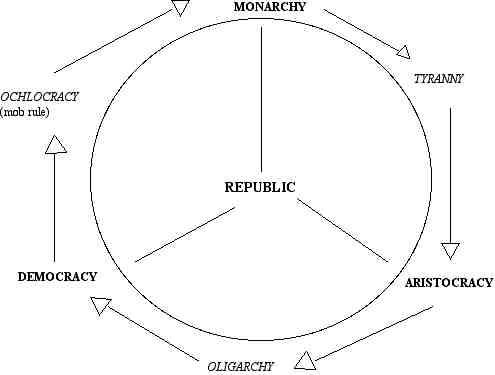
For example, here is the schema of Polybius, a historian and Stoic philosopher of the 2nd century BC:


Polybius classifies forms of government according to whether the ruling class consists of one, a few, or many, and whether the government is genuine (legitimate), meaning that it promotes the good life for all its citizens, or perverted, meaning that it promotes the good life only for the ruling faction. Thus there are six basic forms of government. Governments may also be defective in that they misunderstand what the good life really is, but that’s a separate issue.

According to Polybius, the six basic forms are unstable and tend to succeed each other in a cycle, as each genuine form (monarchy, aristocracy, democracy) degenerates into its corresponding perversion (tyranny, oligarchy, ochlocracy), which is in turn overthrown by the next genuine form. The way to get off this merry-go-round of instability is to form a republic, which is a mixed (or balanced) government that combines the strengths of the three genuine forms. We see here the germ of the idea of checks and balances.

Republican theorists also concern themselves with the qualities that individual citizens must have in order for the state to succeed. This is the idea of civic virtue, meaning the virtue of a person qua citizen, which is not necessarily identical with the virtue of a person qua human being. Personal independence and a willingness to separate personal interests from public affairs, and to subordinate the former to the latter, emerge as the key components of civic virtue. Republican theorists also recognize that in order for the state to be stable, the middle class must predominate. When the citizenry is polarized between the rich and the poor, community breaks down and the state is prone to civil discord or revolution.

The framers of our Constitution were strongly influenced by this tradition, but they were also influenced by another tradition of political philosophy that arose in the aftermath of the English Civil War, namely Liberalism. (By Liberalism, I mean the school of thought that includes contractarian theorists such as Hobbes, Locke, Rousseau, and Rawls, Utilitarians such as Bentham and Mill, and mainstream economists from Adam Smith to Milton Friedman.) Liberalism turned out to be much more congenial to the interests of the rising capitalist class than the older republican tradition and largely, but not completely, eclipsed the latter (cf. Sandel).

There are many interesting points of contrast between these two traditions, of which I shall mention only two: firstly, Liberalism denies that there is such a thing as the good life for human beings that a government should promote; according to Liberalism there are only various individual preferences, and government should not promote any one way of life over the others. Secondly, in place of the republican concern with civic virtue, Liberalism emphasizes the importance of secure property rights as a basis for a sound state.

So how would a eudaimonic economy help us avoid degenerating into oligarchy? Let’s take a closer look at the oligarchic threat.

Oligarchy is rule by a wealthy minority; at its worst, that minority is hereditary. The American republic has not remained static with regard to democracy and oligarchy. At any given point in its history, it has been in motion toward one or the other of these poles. During the Jacksonian period, it moved toward democracy. During the Gilded Age, it moved toward oligarchy: the railroad magnates, “robber baron” capitalists, and trusts were able to use their wealth to corrupt government at all levels, including the U.S. Senate and federal judiciary. The instituting of popular election of senators loosened their grip on the Senate, but the ideological imprint they left on the judiciary lasted well into FDR’s presidency.

From 1933-1980, America became increasingly democratic. Income disparity was reduced. Organized labor won the right to organize. Great gains were made in the areas of civil rights for minorities. Regulatory agencies and liability standards helped balance the interests of individual citizens and consumers against the interests of large enterprises. The airwaves were declared to be public property, and the FCC’s “fairness doctrine” allowed citizens with varying views to present their opinions on broadcast media. Control of the media was dispersed.

Unfortunately, our polity has lurched toward oligarchy during the past thirty years, a trend that has accelerated since 1980. Oligarchical moves have been disguised as attacks on “big government”. “Government is not the solution, it’s the problem!” Reagan said; “Starve the beast!” say reactionaries today. This period has seen a number of oligarchical trends, that is, trends that tend to concentrate power and wealth in fewer hands, and to reduce the accountability of those who exercise that power:
  • Growing income disparity. 
  • Weakened labor unions. 
  • Weakened regulations concerning financial practices, environmental protection, product safety, and workplace safety. 
  • Concentration of media ownership. 
  • Rising costs for political campaigns. 
  • De-funding of services for middle- and lower- income citizens, such as student aid, welfare, and healthcare for the poor. 
  • International trade treaties that promote global capital but do not address labor or environmental issues, and the abuse of international trade treaties to circumvent national and local laws that do. 
  • Decreasingly progressive taxation, which places the burden of supporting government disproportionately on the working poor and middle class, and exacerbates income inequality. 
  • Weakening of the idea of a loyal opposition 
A eudaimonic economy would counter these oligarchic trends by redirecting resources away from concentrated wealth and the corrupt uses of it toward large-scale investment in education and research. Put simply, money that is spent on education and research is money that is not spent on political advertising, lobbyists’ salaries, etc. It is also not spent on wasteful consumer spending, or unnecessary military adventures and weapons systems, or speculative bubbles in securities or real estate. But there are less obvious ways in which education in particular is important. For a post-industrial republic, education is essential to two projects: the development of civic virtue and the preservation of the middle class.

The republican tradition has historically emphasized arms and property as bases of civic virtue and liberty, for these were thought to ensure the independence of the citizen. Those who were dependent upon others for livelihood or protection (dependent in the sense that these others could take away that livelihood or protection at will) were subjects, not citizens.

Concerning arms, the citizen soldier was the paradigm of courage for Aristotle, who also said that this sort of courage was the virtue most likely to be present in “the many”, and similarly Machiavelli thought that participation in the militia was essential to civic virtue. The second amendment of the U.S. Constitution is an echo of early modern republican debates about the dangers of a standing army and older ideas about the need for citizens to take part in their own defense. This is a timely topic, but unfortunately I cannot go into it further here. [I will go into it on this blog --MDR 2018]

Concerning property, in pre-industrial times, possession of a suitable amount of land and the equipment necessary to work it ensured economic independence. Lack of independence made one subject to one’s patron’s whims and led therefore to a servile condition. The ownership of a modest amount of land also bred virtue insofar as it required one to attend to the business of running one’s estate, and certain virtues such as liberality could not be exercised without a minimum of means. Such considerations influenced Thomas Jefferson’s ideal of a yeoman democracy, which is prefigured in Aristotle’s endorsement of democracies that limit the vote to husbandmen.

By the time of the founding of our republic, Liberal and republican thinkers agreed that securing property was a vital function of government (the most vital for Liberals, who, unlike republicans, were not concerned about the dangers of owning too much property). Securely held and fairly distributed real property (land) was also important insofar as it ensured the existence of a middle class, recognized by Aristotle and Cicero to be necessary for the stability of the state. Thus, in a republic, civic virtue goes hand-in-hand with a stable and harmonious class structure.

Home ownership is still an important component of the American Dream, but we can no longer conceive of independence as it was conceived in pre-industrial times, with its paradigm of the relatively self-sufficient gentleman or yeoman farmer who produced his own food on his estate and bore arms in a citizen’s militia. The technological basis for our society entails a complex interdependence among citizens who perform various specialized functions. Most of us do recognize this, implicitly or explicitly; those who live “off the grid” are exceptional.

This brings us again to education. For most Americans, economic independence, in the sense of being able to support oneself, is based on being able to exercise skills that are in demand. This means that having a profession or skilled trade, not land ownership, is the basis of economic security and relative independence, and having a profession or skilled trade usually requires post-secondary formation. Therefore, for most Americans, access to postsecondary education is necessary for the economic independence that is one of the bases of republican civic virtue.

Now for point #5. I’m not going to say much about the feasibility of UAPSE because, frankly, proving the feasibility of UAPSE is too easy to be interesting. (There are approximately 18 million college students in the U.S. Giving each of them a grant of $5000/year would cost less than what we are spending on the Iraq war, and this investment would pay for itself well before today’s freshmen retire.)

Moreover, UAPSE is only a first step toward a eudaimonic economy. So, in the time I have left, I’d like to briefly mention some other steps we can take to move in that direction. Here are some more things we could do to shift our surplus resources away from consumerism and the oligarchic concentration of wealth toward a eudaimonic economy:
  • Fund more basic research. 
  • Promote lifelong education. 
  • Reduce teacher-student ratios. 
  • Lengthen K-12 school years. 
  • Expand offerings (not just university course offerings, but, e.g., foreign language instruction in elementary school). 
  • Provide greater access to early education. 
  • Increase after-school programs. 
  • Provide more opportunities for professional development for educators. 
  • Increase support for public libraries. 
  • Provide adequate arts, music, and physical education in every school. 
  • Shorten the work week. 
That last one is probably the least obvious. A shorter workweek would be conducive to a eudaimonic economy by facilitating lifelong education. Access to lifelong education is of little benefit if people do not have the time to make use of it. A shorter workweek would allow people the option of combining career-oriented work and study, and would enable them to upgrade their skills in response to technological changes. It would also counteract some of the harmful effects of consumerism upon the family by giving people more time to spend with their spouses and children.

America has experimented with large-scale investments in postsecondary education in the past, with the land-grant colleges and the G.I. Bill being perhaps the most conspicuous examples. The successes of these initiatives exceeded the expectations of their authors. The time has come for another round of massive investment in America’s human capital. The Aristotelean and republican tradition of practical philosophy offers a coherent normative rationale for doing so. Unfortunately, Liberalism, which is the dominant political ideology of our society, offers no such rationale and in fact supports the status quo. In order to achieve a eudaimonic economy, it may be necessary to overcome certain Liberal convictions about the role of government and the nature of political association.

Bibliography

Aristotle. The Complete Works of Aristotle, ed. Jonathan Barnes. Princeton: Princeton University Press, 1984.

Bell, Daniel. The Coming of Post-Industrial Society. New York: Basic Books, 1999.

Berlin, Isaiah. “Two Concepts of Liberty”, in The Proper Study of Mankind. New York: Farrar, Strauss, and Giroux, 1998.

Breit, William & Roger L Ransom. The Academic Scribblers. Princeton: Princeton University Press, 1998.

Center for Responsive Politics. “Opensecrets.org--Money in politics data”. <http://www.opensecrets.org/index.asp>

----- “A Brief History of Money in Politics”. 1996. <http://www.opensecrets.org/pubs/history/historyindex.asp>

----- “The Big Picture: The Parties”. <http://www.opensecrets.org/bigpicture/ptytots.asp?cycle=2002>

----- Speaking Freely, 1st ed. <http://www.opensecrets.org/pubs/speaking/speakingindex.html>

CIA World Factbook. “USA”.

Cicero, Marcus Tullius. The Offices, tr. by Thomas Cockman, in Cicero’s Offices (1909). New York: E.P. Dutton, 1909.

-----On the Commonwealth. Tr. by George Holland Sabine and Stanley Barney Smith. Indianapolis: Bobbs-Merrill, 1929.

Cohen, Arthur M. The Shaping of American Higher Education. San Francisco: Jossey-Bass, 1998.

Cohen, Lizabeth. A Consumers’ Republic. New York: Alfred A. Knopf, 2003

Cross, Gary. An All-Consuming Century. New York: Columbia University Press, 2000.

Duderstadt, James J. “The Future of the University in an Age of Knowledge”. JALN vol. 1, issue 2, Aug. 1997.

-----A Roadmap to Michigan’s Future: Meeting the Challenge of a Global Knowledge-Driven Economy. Ann Arbor: The University of Michigan, 2005.

Eddy, Edward Danforth Jr. Colleges for our Land and Time. New York: Harper & Brothers, 1957.

EconSouth. “Higher Education Translates Into Big Business”. Second Quarter, 2000.

Fink, Zera. The Classical Republicans. Evanston: Northwestern University Press, 1945.

Ginsber, Thomas. “Debate over Reagan’s labor legacy continues”, Knight-Ridder, June 10, 2004. On Brotherhood of Locomotive Engineers and Trainmen website: <http://www.ble.org/pr/news/headline.asp?id=10730>

Granholm, Jennifer. “Michigan: Jobs Today, Jobs Tomorrow”. State of the state address, Feb. 8, 2005.

Hamilton, Alexander, John Jay, and James Madison. The Federalist. Edited by Benjamin F. Wright. New York: Barnes & Noble, 2004.

Heilbroner, Robert L. The Wordly Philosophers, 4th ed. New York: Simon & Schuster, 1972.

-----and William Milberg. The Making of Economic Society. Upper Saddle River: Prentice Hall, 2002.

Hobbes, Thomas. Leviathan (excerpt). In Morgan (q.v.).

Hume, David. A Treatise of Human Nature. London: Penguin Books, 1969.

Kennedy, David M. Freedom From Fear. New York: Oxford University Press, 1999.

Keynes, John Maynard. “The End of Laissez-Faire”. 1926. <http://www.panarchy.org/keynes/laissezfaire.1926.html>

Kiester, Edwin jr. “The G.I. Bill may be the best deal ever made by Uncle Sam”. Smithsonian, Nov. 1994.

Lt. Governor’s Commission on Higher Education and Economic Growth, the. Final Report. Dec. 2004.

Locke, John. Second Treatise of Government. In Morgan (q.v.)

Machiavelli, Niccolo. Discourses on the First Ten Books of Titus Livius. In The Prince and The Discourses. New York: Random House, 1950.

MacIntyre, Alisdair. After Virtue, 2nd ed. Notre Dame: University of Notre Dame Press, 1984.

----Whose Justice? Which Rationality? Notre Dame: University of Notre Dame Press, 1988.

Maynor, John W. Republicanism in the Modern World. Cambridge: Polity Press, 2003.

Mill, John Stuart. "On Liberty" and "Utilitarianism". In Morgan (q.v.).

Miller, Roger Leroy. Economics Today, 10th ed. Reading: Addison-Wesley, 1998.

Morgan, Michael L., ed. Classics of Moral and Political Philosophy. Indianapolis: Hackett, 1992.

Mortenson, Thomas G. “The Crisis of Access in Higher Education”, in Academe, Nov.-Dec. 2000.

Mumford, Lewis. “Authoritarian and Democratic Technics”. In Questioning Technology, J. Zeryan & A. Caines, eds. London: Freedom Press, 1988.

-----Technics and Civilization. San Diego: Harcourt Brace & Co., 1963.

Nelson, Eric. The Greek Republicans (excerpt). Cambridge University Press 2004. Excerpt on Cambridge University Press catalog website.

Phillips, Kevin. Wealth and Democracy. New York: Broadway Books, 2002.

Pettit, Phillip. Republicanism: A Theory of Freedom and Government. Oxford: Oxford University Press, 1997.

Pocock, J.G.A. The Machiavellian Moment. Princeton: Princeton University Press, 1975.

Potter, David M. People of Plenty. Chicago: University of Chicago press, 1954.

Rawls, John. Justice as Fairness: A Restatement. Cambridge: Harvard University Press, 2001.

Rones. Philip L., Randy E. Ilg, and Jennifer M. Gardner. “Trends in hours of work since the mid-1970s”, Monthly Labor Review, April 1997.

Rosenblatt, Roger, ed. Consuming Desires. Washington: Island Press, 1999.

Rousseau, Jean-Jacques. On the Social Contract. In Morgan (q.v.)

Russel, James A., and James J. Wirtz. “Preventive War in Iraq”. Center for Contemporary Conflict, Nov. 4, 2002. <http://www.ccc.nps.navy.mil/rsepResources/si/nov02/middleEast.asp>

Karen Schaefer. “Environmental Effects of Free Trade”. Aired April 22, 2002. <http://www.wcpn.org/news/2002/04-06/0422free_trade.html>

Sandel, Michael. Democracy’s Discontent. Cambridge: Harvard, 1998.

Schlesinger, Arthur. The Crisis of the Old Order. Boston: Houghton Mifflin, 1957.

Skinner, Quentin. Liberty Before Liberalism. Cambridge: Cambridge University Press, 1998.

SRI. Economic Impact of Michigan’s State Universities. Lansing: Partnership for Economic Progress, 2002.

Stearns, Peter N. Consumerism in World History. New York: Routledge, 2001.

U.S. Bureau of Census. Measuring 50 Years of Economic Change Using the March Current Population Survey (Current Population Reports, P60-203). Washington: U.S. Government Printing Office, 1998.

-----The Changing Shape of the Nation’s Income Distribution 1947-1998 (CPR P60-204). 2000.

-----Poverty in the United States: 2002 (CPR P60-222). 2003.

-----Income, Poverty, and Health Insurance Coverage in the United States: 2003 (CPR P60-226). 2004.

U.S. Bureau of Economic Analysis. <http://www.bea.gov>

U.S. Bureau of Labor Statistics. <http://data.bls.gov>

U.S. Department of Veterans Affairs. “History of GI Bill”. <http://www.gibill.va.gov/education/GI_Bill.htm>

Veblen, Thorstein. Theory of the Leisure Class. New York: Random House, 1934.

Wood, Gordon S. The Radicalism of the American Revolution. Alfred A. Knopf: New York, 1992.


Copyright 2008 M. D. Robertson. The author grants permission to reprint, republish, or distribute this work with attribution for non-commercial purposes.

[Orthographical note: Macintyre and many others prefer "Aristotelian". I prefer "Aristotelean" on etymological grounds. --MDR 2018]

New blog: Logos and Liberty

 I've decided to start a new blog on Substack, which I have titled Logos and Liberty . I am doing this for three reasons: first, I want ...