Here's another of my old conference papers. This one was presented at the Rhetoric Society of America biennial meeting in 2012.
Authors, Roles, and Subjects
M. D. Robertson
Mikhail Bakhtin and Michel Foucault present different views of the speaking individual. Bakhtin’s view suggests that the speaker has a greater degree of freedom than Foucault’s view allows. Judith Butler’s exploration of the concept of the subject is based on Foucault’s view, but Butler’s concerns about performativity and agency could be addressed more coherently using a notion of the subject that is based on Bakhtin’s view, rather than Foucault’s, and clarified by adding the concept of role.
1. The author in Bakhtin
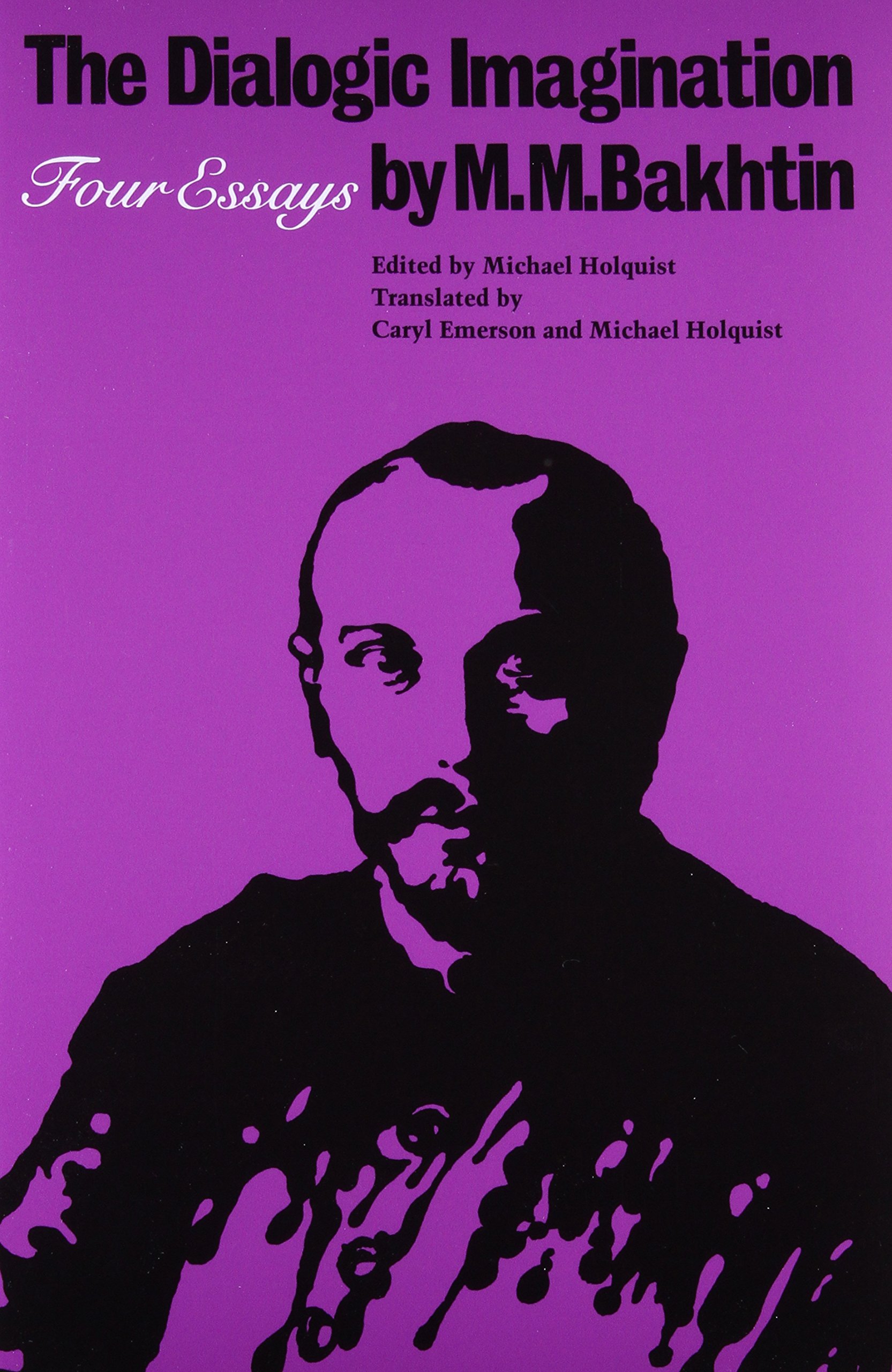
Michael Holquist, in his introduction to Bakhtin's The Dialogic Imagination, speaks of the phenomenon of language and “that other phenomenon which it ventriloquates, man” (xviii). This statement suggests that Holquist wants to count Bakhtin among those who say that we do not speak language–language speaks us.
But Bakhtin seems to directly contradict Holquist’s statement when he says, “[The author] speaks, as it were, through language, a language . . . that he merely ventriloquates” (299). This clearly portrays the author as Edgar Bergen and language as Charlie McCarthy, not vice versa.
Bakhtin’s theory of language is based on the intertwined concepts of dialogism and heteroglossia. Against linguistics, stylistics, and the philosophy of language, which all posit unitary and discrete normative national languages and individuals who each speak in exactly one such language (or exactly one deviant version of such a language), Bakhtin asserts that such a view of language is a fictional abstraction. Actual language in use is always caught in the interplay between “centripetal” forces that tend towards greater standardization of speech, and “centrifugal” forces that tend towards greater diversity of speech. The latter are stronger, both diachronically and synchronically. Speakers do not speak a single language, they speak a blend of dialects associated with various elements of society, a blend which varies from one utterance to the next. Heteroglossia refers to the mixture of interacting languages that compose any identifiable national “language”. Dialogism means that, in non-poetic uses of language, an individual does not speak in a single language of her own choosing; speech (la parole) will always draw from a mixture of languages (les langues), like a ladle dipped into a pot of stew.
Heteroglossia and dialogism shape the dialect(s) that speakers use, but it is a mistake to infer from this that speakers have no control over what they say in those dialects. Bakhtin’s discussion of authorship makes this clear.
Bakhtin discusses both poetic and prosaic authorship. The main difference between them is that the poet resists heteroglossia and centripetal and centrifugal forces that shape language and strives to create a language of his own, while the novelist embraces heteroglossia and uses the existing social dialects that he is aware of.
In the majority of poetic genres . . . the internal dialogization of discourse is not put to artistic use, it does not enter into the work’s ‘aesthetic object’. In the novel, however, this internal dialogization becomes one of the most fundamental aspects of prose style and undergoes a specific artistic elaboration. (284)
But in neither case is the author’s intentions determined by the language.
The language of the poet is his language . . . he makes use of each form, each word, each expression . . . as a pure and direct expression of his own intention. (285)
The prose writer makes use of words that are already populated with the social intentions of others and compels them to serve his own new intentions, to serve a second master. (300)
The novelist can be compared to a sailor, who does not control the winds and currents, but is able to harness them and arrive at a destination of his own choosing.
2. The subject in Foucault
Foucault also discusses authorship (broadly construed) in The Archaeology of Knowledge, and he shares Bakhtin’s concern with the concrete use of language in particular social contexts, as opposed to abstract analyses of language. Foucault focuses on “statements”, which he describes but does not define. He distinguishes statements from propositions, sentences, and speech acts; he seems to have in mind roughly what French linguists call “the utterance” (l’énoncé), but with special attention paid to the relationship between the statement and the “subject” of the statement (92), which he distinguishes from the author:
But the “author” is not identical with the subject of the statement; and the relation of production that he has with the formulation is not superposable to the relation that unites the enunciating subject and what he states. . . . .
So it seems that while the author may “produce” language, it is the subject which originates statements.
Unfortunately, Foucault is not altogether clear about what he means by the subject.
Generally speaking, it would seem, at first sight at least, that the subject of the statement is precisely he who has produced the various elements, with the intention of conveying meaning. Yet things are not so simple. . . . the statements of the novel do not have the same subject when they provide, as if from the outside, the historical and spatial setting of the story, when they describe things as they would be seen by an anonymous, invisible, neutral individual . . . , or when they provide . . . the verbal version of what is silently experienced by a character. Although the author is the same in each case, . . . . they do not imply the same relation between this subject and what is being stated. (93)
Let it be noted that Bakhtin is able to take these distinctions into account and still show how and in what sense the author is the originator of the novel.
The following is perhaps the clearest indication of what Foucault means by “subject”:
So the subject of the statement should not be regarded as identical with the author of the formulation. . . . . it is a particular, vacant place that may in fact be filled by different individuals . . . . (95)
Thus, Foucault distinguishes between the individual (the author) and the subject. The metaphor of subject as place reoccurs in this quotation:
If a proposition, a sentence, a group of signs can be called “statement”, it is not therefore because, one day, someone happened to speak them or put them into some concrete form of writing; it is because the position of the subject can be assigned. To describe a formulation qua statement does not consist in analyzing the relations between author and what he says (or wanted to say, or said without wanting to); but in determining what position can and must be occupied by any individual if he is to be the subject of it. (95)
So it seems that statements emanate from positions that individuals occupy, not from individuals themselves.
3. The subject in Butler
Butler acknowledges her debt to Foucault in her account of the subject, especially his account of assujetissement in Power/Knowledge, History of Sexuality, and Discipline and Punish (Butler, 16). According to this account, how an individual comes to occupy a given subject position is a function of the “regulatory power” that is described in Discipline and Punish, or some similar discursively mediated social process, or possibly a set of conflicting processes of opposing powers, but in any case neither the subject nor the statements that emanate from it originate with the individual.
If this is what Foucault means*, then his theory, and not Bakhtin’s, is the one in which language “ventriloquates” man, or rather, power ventriloquates man. The subject position, from which statements emanate, is constituted by power relations and imposed upon the individual, unlike Bakhtin’s author, who freely originates his own communicative intentions.
Following Foucault, Butler also distinguishes the subject from the individual. In her work The Psychic Life of Power, she says,
“The subject” is sometimes bandied about as if it were interchangeable with “the person” or “the individual”. The genealogy of the subject as a critical category, however, suggests that the subject, rather than be identified strictly with the individual, ought to be designated as a linguistic category, a placeholder, a structure in formation. Individuals come to occupy the site of the subject . . . and they enjoy intelligibility only to the extent that they are, as it were, first established in language. (11)
She continues to explore the distinction between the subject and the individual further in Gender Trouble. But in her separation of the individual from the subject, she seems to go farther than Foucault. Foucault separates the subject from the individual in order to elucidate the social construction of knowledge; it is not clear that he intends to present a metaphysical account of personhood, which seems to be how Butler is construing him. Butler’s metaphysical construal of Foucault gets her into difficulties, because she has not clearly worked out the relationship between the individual and the subject:
Paradoxically, no intelligible reference to individuals or their becoming can take place without a prior reference to their status as subjects. (11)
This is only the first of several places in which Butler explicitly or implicitly acknowledges paradox, contradiction, or circularity (logical, temporal, and/or causal) in her account of the subject.
Butler seems to recognize this conceptual difficulty, but apparently she regards it aporetically. It complicates the issue of agency for her:
As much as a perspective on the subject requires an evacuation of the first person, a suspension of the “I” in the interests of an analysis of subject formation, so a reassumption of that first-person perspective is compelled by the question of agency.
Agency and the first-person perspective are indeed inseparable. Any account of the subject or individual that makes its behavior completely determined by impersonal forces, be they biological or social, renders the subject devoid of agency in any ethically relevant sense. But this is precisely what Butler’s analysis of the subject runs the risk of doing when she makes the subject a position constructed by power relations and paradoxically questions the existence of the individual apart from any subject position.
This unnecessary mystification seems to be motivated partly by her rejection of the metaphysics of substance. She acknowledges the influence of Michel Haar and others who, expanding on a theme of Nietzsche’s, assert that the metaphysics of substance is an illusion based upon the reification of grammatical categories (GT 28). But such arguments grossly misrepresent substance metaphysics. The relationship between language and reality is the very first topic that Aristotle takes up in the very first chapter of the very first work of the corpus that has come down to us (Categories), and he clearly shows that a noun and a substance are not the same thing.
Could there be another account of the subject and the individual that will address the issue of agency without taking on the unnecessary burden of refuting Aristotle and Descartes, and which do not get bogged down in paradoxes? Bakhtin’s account of the author points the way to an alternative. I will attempt to sketch such an alternative in the following section.
4. Individuals, roles, and subjects
If the distinction between individual and the subject is retained, then to which of these does the first-person perspective pertain? Clearly to the former, for it is the individual (i.e., the person, the self, the “I”) that suffers, not some “site” or “position” that the individual occupies.
But different individuals suffer in different ways. Suffering which is properly called oppression or exploitation does seem to have something to do with the “position” that an individual occupies within a network of social relations.
I think this can be clarified by reexamining the old concept of role. For the purposes of this argument, I shall define a role as a set of tasks that a particular member of a human community must perform in order to avoid a loss of status. I shall further define a task as an activity that must be performed in order to meet one or more perceived needs of at least one member of a human community. Lastly, I propose that a subject can be understood as an individual together with that individual’s role.
With this in mind, the paradoxes Butler alludes to can be solved by recognizing that the individual is prior to the subject. Evidence for this can be found in the case histories of pre-linguistic individuals: the Wild Boy of Aveyron, Helen Keller, and Genie the Wild Child. These individuals were human beings, but for many years they did not lead fully human lives, because they had no roles within any human community. Thus, they were individuals but they were not subjects.
Bakhtin’s sociolinguistic perspective further elucidates the connections between individuals, roles, and subjects. It is no coincidence that the individuals who were not subjects were also incapable of communicating. They had no roles because they could not engage in dialogue. Here is a way of understanding the “discursive formation of the subject”: individuals cannot assume a role without being informed about the tasks involved in that role through some sort of discourse. Discourse will also be necessary to communicate to individuals the consequences of assuming or failing to assume certain roles.
Bakhtin’s concept of heteroglossia can also apply here, for one of the tasks associated with most roles is to speak the social dialect associated with that role, and, conversely, to be a speaker of a given social dialect may involve taking on certain roles. But Bakhtin’s account of authorship allows the discursive formation of the subject without degenerating into an extreme Whorfianism that would destroy the individual freedom of thought and action that are necessary conditions for agency.
Bakhtin’s centripetal and centrifugal forces also apply to roles. Roles change over time, just as language does, though I cannot say whether change of language causes, is caused by, or is coincidental to change of roles.
5. Agency and Performativity
Does this account of the subject contribute anything to Butler’s projects? I believe that it does.
Firstly, it helps make sense of agency. Butler’s initial account divorced the subject from the “I” but then could not consistently attribute agency to the subject. I will venture that agency consists of the metaphysical freedom of the individual mediated through the possibilities and constraints inherent in that individual’s role. Thus, agency can be attributed to the subject (individual + role) without breaking the link between agency and the first person perspective.
Secondly, it supports the concept of performativity without essentialism. Gender can easily be construed as a kind of role within this framework, and roles are constructs which are never intrinsic to individuals.
Thirdly, it supports the idea of subjection (the process whereby an individual takes on a role) being both subordinating and empowering. This suggests a way of understanding liberatory projects: oppressed individuals can be liberated by enabling them to either (a) take on different roles, or (b) redefine the roles they already have.
Fourthly, it ties in with Butler’s idea of an “inassimilable remainder”. Individuals are prior to and more than the roles that they take on, so an account of their subjecthood can never be a complete account of their personhood.
Finally, it steers between the Scylla of “politically sanctimonious forms of fatalism” and the Charybdis of “naive forms of political optimism” (17) by affirming the freedom of the individual while recognizing the constraints inherent in the roles that individuals are subjected to.
Footnote
* I say "if" because in History of Sexuality, Foucault repeatedly speaks of “the individual constituting himself as a subject”.
Works Cited
Aristotle. Categories.
Bakhtin, Mikhail. “Discourse in the Novel”, in The Dialogic Imagination, edited by Michael Holquist. Austin: University of Texas Press, 1981.
Foucault, Michel. The Archaeology of Knowledge. New York: Pantheon Books, 1972.
-----Discipline and Punish. New York: Random House, 1995.
-----The History of Sexuality. New York: Random House, 1990.
Butler, Judith. The Psychic Life of Power. Stanford: Stanford University Press, 1997.
-----Gender Trouble. New York: Routledge, 1990.